NaCzarter Team
· Updated
How a lifejacket differs from a buoyancy aid
A lifejacket (100 N and up) has a collar and turns an unconscious person face up. A buoyancy aid (50 N) only helps a swimmer stay afloat close to the boat. A child wears a lifejacket chosen by body weight. Lifejackets are part of the inventory on almost every yacht on NaCzarter, but confirm a child's size with the owner.
The difference shows in the water, after a blow to the head from the boom. The 2022 guidance for water scouts of the ZHR scouting association puts it plainly: "even the best swimmer loses consciousness after a close encounter with the boom".
Buoyancy classes: 50, 100, 150 and 275 N
The EN ISO 12402 standard (in Poland PN-EN ISO 12402 of 2021) has four levels; 100 N is roughly 10 kg of buoyant force. Only the classes from 100 N upwards are lifejackets. A 50 N device is a "buoyancy aid", even though shops sell it as a lifejacket.
| Class | What it does | Who it is for | Where in Masuria |
|---|---|---|---|
| 50 N, buoyancy aid | Helps you stay afloat. No collar, does not turn an unconscious person | Swimmers close to help; not for children under 30 kg | A swimmer in the cockpit in light wind, towed sports |
| 100 N, lifejacket | The collar supports the head and turns you onto your back (heavy clothing weakens this) | Children (by weight), non-swimmers, anyone waiting for rescue | Sheltered and inland waters, which means the Masurian lakes |
| 150 N, lifejacket | General use, meant to turn an unconscious person; foul-weather gear can weaken this. Usually inflatable | Skipper and crew on passage | Śniardwy and Mamry in a seaway, at night, in stormy weather |
| 275 N, lifejacket | Extreme conditions, clothing with its own buoyancy, heavy gear | Professionals, the ocean | Not needed on the lakes |
Table data based on the EN ISO 12402 standard and the German DGUV Regel 112-201. The nominal 50 N depends on size, because according to the Lalizas product sheet the same model gives a child 40 N and an adult 55 N.
What the rules say: the duty to carry versus the duty to wear
A lifejacket for every person on board
Under § 6(1) of the 2010 regulation of the Minister of Infrastructure on the equipment of inland vessels (rozporządzenie), there must be as many lifebelts or lifejackets on board as there are people, plus lifebuoys. The same amount of safety equipment is required by § 2 of the 2013 regulation on safety in water tourism (rozporządzenie). Lifejackets must carry valid certification (§ 9 of the 2010 regulation), but the rules do not specify a minimum class in newtons. The forum claim that "inland waters require 100 N" is a myth. That said, under the standard a 50 N device is not a lifejacket and does not count towards the full set.
Who has to wear one
Under § 5 of the 2013 regulation, a person who cannot swim must wear a lifejacket or buoyancy aid while on board. For everyone else the person in charge of the vessel decides (§ 3(2)), and before departure they check the equipment and show the crew how to use it (§ 3(3)). The law and the standard part ways here, because § 5 allows non-swimmers a buoyancy aid, although under the standard 50 N is not meant for them. So give a non-swimmer a lifejacket.
What the ministry recommends
The Ministry of Infrastructure's guide for sailors advises wearing lifejackets at night and in difficult conditions, and also on small centreboard dinghies, which capsize easily. In a 2025 letter the ministry adds: "the person in charge of the vessel, seeing a threat approaching, should always call on the yacht's passengers to put on lifejackets". A squall is one such threat, so check the weather in Masuria before you set off.
Which lifejacket for a child, and when to put it on
There is no separate rule about a child in a lifejacket. A small child cannot swim, so § 5 covers them, and with older children you decide, as the skipper. In practice a child wears a lifejacket whenever the yacht is under way, even if they can swim, and small children wear one on the pontoon too.
Choose by weight, not age. Children's 100 N lifejackets have a body-weight range on the label, for example 15 to 40 kg, and outside that range the manufacturer does not guarantee that the child will be turned face up. Check for a stiff collar, a crotch strap (without it the jacket rides up under the chin), a whistle and a grab handle on the back. After buckling it up, pull the lifejacket upwards by the shoulders, and if it slides above the child's ears, it is too big. Practise putting it on ashore, and on a warm day run a test in shallow water, standing next to the child, and see whether the lifejacket keeps the head of a child lying on their back above water.
What a lifejacket does was shown on Lake Seksty on 7 August 2026. Wind capsized four sailing boats of a sailing camp with 37 people aboard, 31 of them children; 32 people ended up in the water. According to Polsat News, everyone had lifejackets, everyone was evacuated and one person was taken to hospital. Before you set off, also check how to call for help in Masuria.
Inflatable or foam
Foam always works. It is bulky and hot, though, so adults are quick to take it off. An inflatable lifejacket is a chamber folded into a narrow collar, filled from a CO2 cylinder after immersion or by hand, with a pull cord. It usually gives 150 N and you can wear it all day, but it will not inflate when the cylinder is unscrewed or empty, or the firing cartridge has expired.
So with an inflatable, check that the indicator is green, the cylinder is screwed in tight and the automatic firing cartridge does not expire within the year. Rain will not set the cartridge off, because the hydrostatic trigger only fires about 10 cm under water.
If the automatic trigger fails, pull the cord and top up through the oral tube. Your own lifejacket makes sense if you sail several times a year (a 150 N inflatable that you will actually wear), and for a child when the owner does not have their size.
At yacht handover, count the lifejackets and enter them in the report
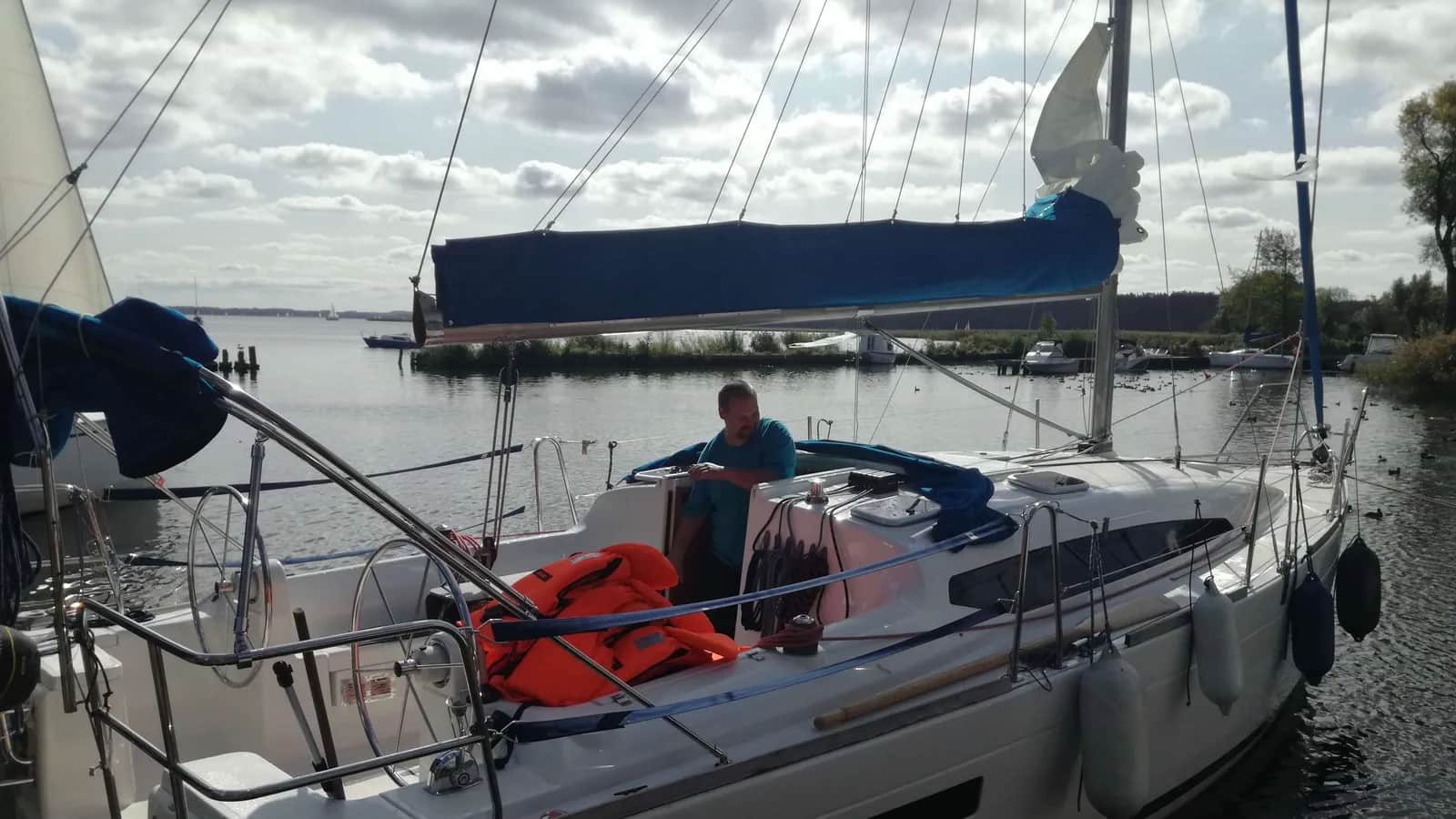
When the owner shows you the cockpit locker, take the lifejackets out:
- Count them. There should be as many lifejackets as people, and a lifebuoy. Eight people and six lifejackets is too few, even if the listing says "lifejackets included".
- Check the labels for the EN ISO 12402 standard, the class in newtons and the weight range, especially on children's lifejackets.
- Inspect the seams, buckles, crotch strap, whistle and reflective tape. Compacted foam or a torn-off buckle is grounds for replacement.
- Assign the lifejackets. The ministry's guide advises that everyone has their own for the whole trip, tried on in port, not out on Śniardwy.
- Enter the number and the sizes in the handover report.
If a lifejacket or a child's size is missing, the owner delivers the missing one or swaps it while you wait at the quay. You do not leave without a full set. On a houseboat sailed without a licence, the owner runs a safety briefing before the rental (Article 37a of the Act), and you tick off the list above just the same. Then practise the man overboard manoeuvre with the crew, because a lifejacket keeps a person afloat, but it is the crew that gets them out of the water.
Frequently asked questions
Does a yacht have to carry a lifejacket for every person? Yes, as many as there are people on board, plus a lifebuoy.
Do you have to wear a lifejacket on a yacht? By law only a person who cannot swim and a person being towed. For everyone else the skipper decides, and the ministry recommends lifejackets at night, in bad weather and before a squall.
Is a 50 N buoyancy aid enough for Masuria? For an adult swimmer in the cockpit in light wind it is enough as a buoyancy aid. It will not turn an unconscious person, though, so children and non-swimmers wear a lifejacket.
Which lifejacket for a child on a yacht? A 100 N lifejacket with a weight range that covers the child, with a collar and a crotch strap. If the owner does not have that size, bring your own.
What is the fine for having no lifejackets on a boat? An on-the-spot fine of up to 500 PLN, a court fine of 20 to 5000 PLN (Article 62(2) of the Inland Navigation Act). There is no fixed tariff.
Cover photo: NaCzarter.pl