
NaCzarter Team
Can a sailboat capsize?
It can, but a ballasted cabin charter yacht heels over and comes back up. It usually takes a chain of mistakes to capsize one: too much sail in a squall, a mainsheet cleated tight, hatches left open. Heeling is normal. Once it goes past about 25 degrees and the rail dips under water, you ease the sheet, head up and reef.
It is one of the first questions people ask before their first charter. To be honest, there is no sailboat that can never tip over. But a small dinghy and a yacht you live on for a week are two different worlds.
A small centreboard dinghy without ballast, such as the Omega, stays upright thanks to its wide hull and the weight of the crew hiking out over the side. Let the sheet go too late in a gust and you end up on your side in the water. On sailing courses in boats like that, capsizing is part of the lesson. A cabin charter yacht carries ballast, weighs several tonnes and behaves differently: she heels, then comes back.
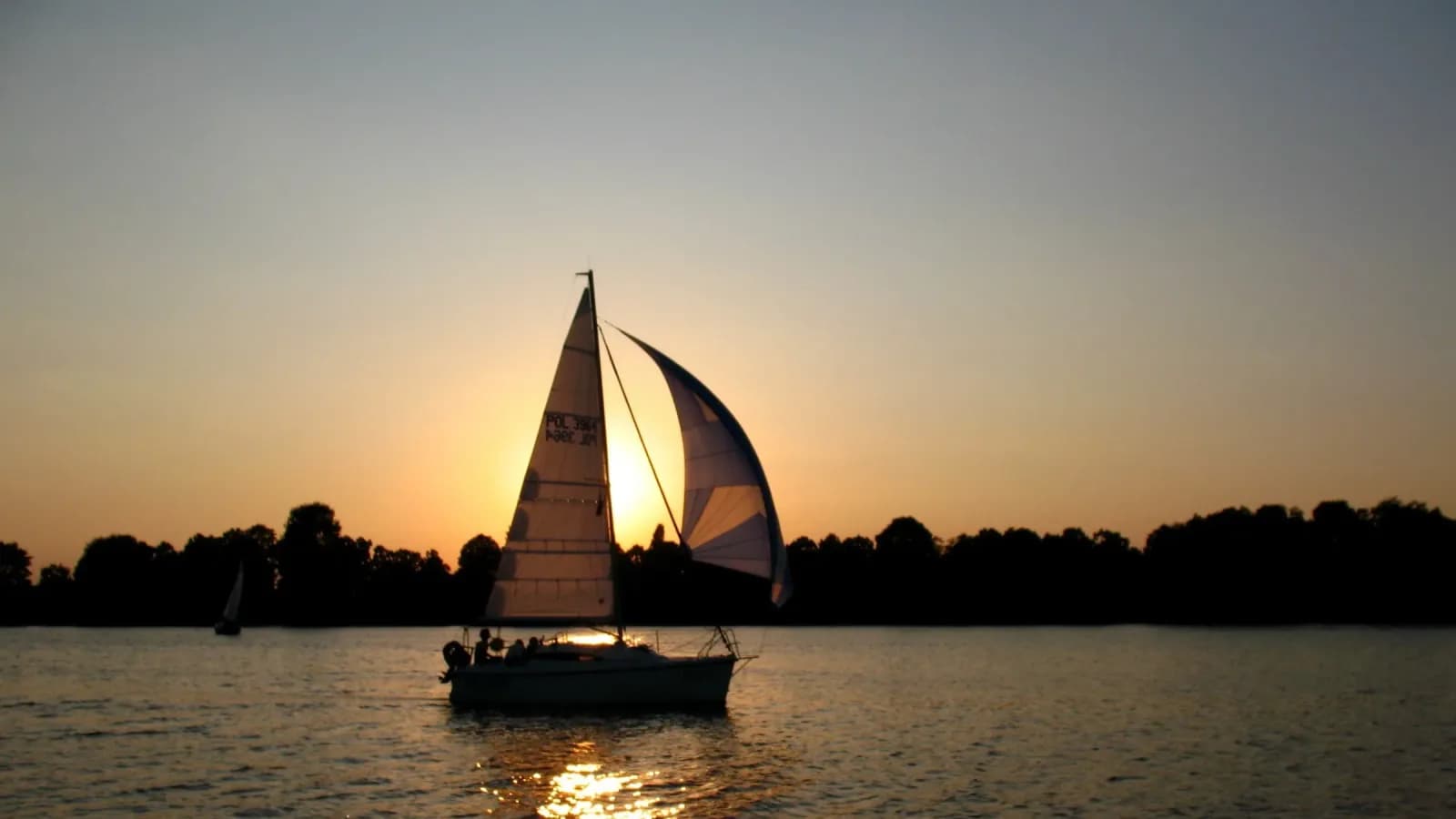
A typical scene from the first hour on Niegocin. A gust hits, the yacht leans over, the kids squeal, someone grabs a mug of coffee sliding across the table. The helmsman eases the mainsheet and the boat pops back up like a roly-poly toy. Half an hour later everyone is sitting on the windward side laughing. That is heeling. Capsizing is something else.
Why does a ballasted yacht right itself?
No formulas. The wind pushes on the sails high above the water and tips the yacht over. The water pushes the hull upwards. As the boat heels, the submerged part of the hull shifts to the leeward side, and with it the point where the water "props her up". The weight stays closer to the centreline. The two forces no longer act along one line, so they form a couple that turns the yacht back upright. Physicist Sławomir Brzezowski describes this in "Foton", the magazine of the Institute of Physics at the Jagiellonian University, and he opens bluntly: a yacht can of course capsize, and how prone she is to it depends on her design.
A flat-bottomed boat without ballast defends itself only through that shift in buoyancy, so a strong enough gust will eventually lay her flat. Ballast adds a second mechanism: the weight sits low and pulls downwards. The lower it is, the harder it works. On a seagoing yacht with a heavy keel this is enough for a boat knocked flat to stand up again on her own. A Masurian charter yacht sits somewhere in between. She is shallow, has a wide hull and ballast either in the hull or in a lifting keel, so both shape and weight do the work. She heels and comes back, but she does not have the reserve of a seagoing keelboat.
The same author adds a downside: a ballasted yacht that floods through openings in the deck sinks. We will come back to that. Some comfort on the wind side: the NauticEd sailing school says that at 30 degrees of heel the heeling moment drops to roughly three quarters.
Centreboard, lifting keel or fixed keel: what is under a Masurian yacht?
The Masurian lakes are shallow, so charter yachts almost always have something underneath that lifts. In the listings on NaCzarter (2026 season, 137 sailboats from 17 owners) the draft with everything raised is 0.3 to 0.7 m, with a median of 0.4 m. Lowered, half of the yachts fall between 1.5 and 1.8 m, with a median of 1.7 m. Every one of those 137 sailboats is listed with two drafts, raised and lowered. None has a fixed draft.
Two popular examples, both well represented on the platform (Antila 33 and 33.3 together account for 19 yachts, the Maxus 33.1 RS for 5 yachts from 3 owners):
- Antila 33.3 has a pivoting centreboard. Dealer listings put the centreboard at about 120 kg and the ballast in the hull at about one and a half tonnes (1450 to 1600 kg depending on the listing). Draft is 0.45 m with the board up and 1.80 m with it down. The weight in the hull is what rights her; the centreboard mainly provides lateral resistance.
- Maxus 33.1 RS has a lifting ballast keel. The Northman yard gives a draft of 0.45 m raised and 1.70 m lowered for this version. The keel is heavier than a light centreboard, but ask the owner at handover exactly how the weight is split between the keel and the hull.
Fixed keels do exist, just not in Masurian charter. The same yard builds a ballasted Maxus 33.1 RS with a 1.80 m draft. There is no such sailboat in the NaCzarter listings, because with a fixed draft you can only reach part of the bays and approaches. We compare both boats in detail in Antila 33 or Maxus 33.1 RS.
| Under the yacht | How it works | Draft in Masuria | Example | What to watch for |
|---|---|---|---|---|
| Pivoting centreboard | A light board swings in its case and provides lateral resistance; the ballast in the hull does most of the righting | 0.45 m raised, 1.80 m lowered | Antila 33.3 | With the board up the yacht slides sideways and points badly |
| Lifting ballast keel | A heavier keel raised into the hull; lowered, it gives lateral resistance and keeps the weight low | 0.45 m raised, 1.70 m lowered | Maxus 33.1 RS | Raised keel means the weight sits higher, so don't sail like that in strong wind |
| Fixed keel | Ballast permanently under the hull, nothing lifts | none in the NaCzarter listings; the ballasted Maxus has 1.80 m | none in the NaCzarter listings | Shuts you out of shallow bays and wild shores |
| Centreboard dinghy without ballast | Stays up on hull width and crew weight | Omega: 16 cm with the board up | Omega | Capsizing is a real possibility, wear a life jacket |
How much heel is still normal?
A sailing yacht sails heeled, and that is how it should be. In light wind NauticEd even suggests moving to the leeward side to get at least about 5 degrees of heel, because that is when the sails take a good shape. The school puts the upper limit at around 25 degrees. Beyond that most cruising yachts do not go any faster, they just labour, and that is the moment to reef. At 45 degrees, according to them, the rudder loses roughly 30 percent of its area in the water, so it stops responding.
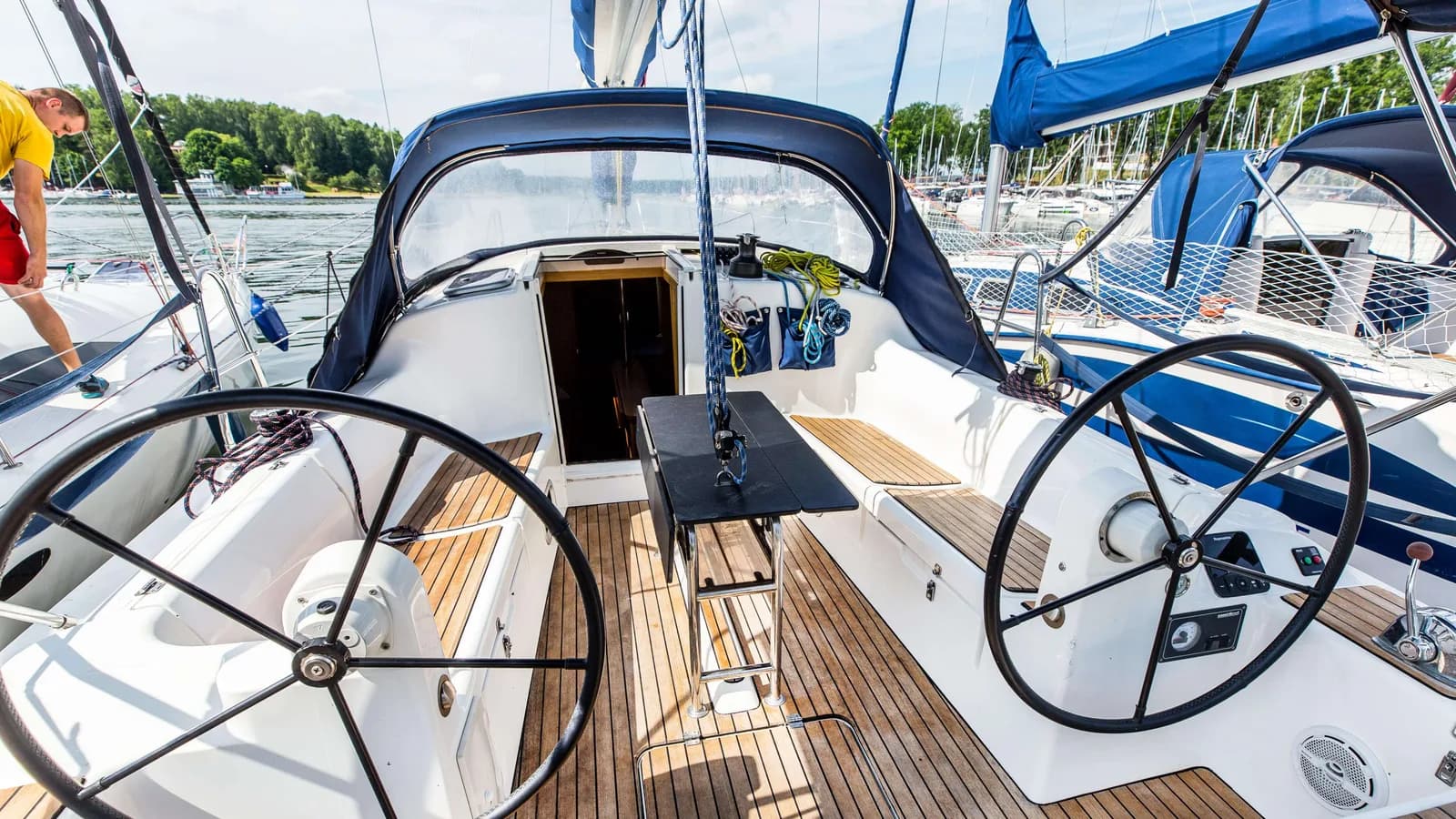
Nobody on board measures with a protractor. The practical test is simpler: if the leeward rail is going under and the helm is pulling hard, you have too much sail up. That pull is weather helm. The yacht wants to turn her bow into the wind on her own and in the next gust she may round up without asking.
What to do when the yacht heels too far?
- Ease the mainsheet. Keep the sheet in hand, not cleated tight.
- Head up. Steer slightly towards the wind until the sails start to flutter along the leading edge. The yacht stands up.
- Reef or roll away some of the jib. If the gusts keep coming, reduce sail. A jib on a roller furler is the quickest to reduce. How to reef the main without stress is covered in our guide reefing sails: when and how. The old sailors' rule says that if you are thinking about reefing, it was already time.
- Check what is underneath. When sailing on open water the centreboard or keel should be down, otherwise the boat slides sideways. Raise it in the shallows and when approaching the shore, so you don't catch the bottom. At handover, ask the owner how the lifting works on that particular boat and how to set it in canals and harbours.
- Close the hatches and the companionway. When heeling hard, water through an open hatch is the shortest route from fright to real trouble.
- Put the life jackets on. In strong wind they belong on people, not in the cockpit locker.
A lot of heeling also comes from badly set sails. A mainsail sheeted in hard acts like a lever in a gust and lays the boat over. You will find the basics in our piece on sail trim for beginners.
When does a squall really threaten a capsize?
Day to day, a ballasted yacht forgives a lot. A squall forgives less, because it arrives fast and hits a yacht carrying sails set for lighter wind. On Śniardwy and Mamry you also get short, steep waves, so when strong wind is forecast you cross them in the morning or not at all.
Along the Great Masurian Lakes route there are warning masts with yellow lights. 40 flashes a minute means a warning, 90 flashes means an alarm: sails down or deeply reefed and straight into harbour or the shelter of the shore. Head for harbour in good time, not when the cloud is already standing over the lake. If a squall catches you, first take the power out with the sheets, furl the jib, start the engine and keep the bow close to the wind. We explain what a white squall in Masuria is and where the mast system came from in a separate article. In case something goes wrong, save in your phone how to call for help in Masuria.
Is there a yacht that cannot capsize?
No. Ballast gives you a big margin, but it does not replace common sense. Open hatches and water in the cabin change everything, because a ballasted yacht taking on water has nothing to keep her afloat. Too much sail in a squall and a mainsheet cleated tight are the classic start of a bad story.
Fear of heeling usually fades after the first day. Respect for squalls should stay with you for the whole trip. If you don't feel confident, some owners on NaCzarter offer a skipper for an extra fee who will show you on the first day how the boat reacts to the wind.
Frequently asked questions
Can a sailboat capsize in Masuria? Yes. A small centreboard dinghy without ballast, like the Omega, capsizes easily. A ballasted cabin yacht heels and comes back, and it usually takes several mistakes at once to capsize one.
How much heel is safe? Noticeable heel is normal sailing. The NauticEd school gives about 25 degrees as the point beyond which most cruising yachts should reef. In practice, the leeward rail in the water and a helm pulling hard mean you have too much sail up.
What is the difference between a centreboard and a keel? A centreboard lifts and mainly provides lateral resistance. On yachts with a light centreboard, such as the Antila 33.3, the righting comes mostly from ballast in the hull. A fixed keel is ballast permanently fitted under the hull. The NaCzarter listings have no sailboats with a fixed draft, only pivoting centreboards and lifting ballast keels.
When do you raise the centreboard? In the shallows and when approaching the shore. When sailing on open water the centreboard or keel stays down, otherwise the yacht drifts sideways. The owner will tell you at handover how to set it in a canal and in harbour.
What should you do when the yacht heels too much? Ease the mainsheet and head up slightly, and if the gusts keep coming, reef the main or roll away some of the jib. Close the hatches and put on life jackets.