NaCzarter Team
What are the parts of a yacht called?
The bow is the front of the yacht, the stern is the back, and the sides are port (left) and starboard (right), looking towards the bow. Under the water you have a centreboard or a fin keel, plus the rudder. In the cockpit you steer with a tiller (sailboats up to about 9 m) or a wheel, and below deck there is the saloon, the galley (the kitchen), the berths and the toilet.
On top of that come a dozen or so words you will hear from the boatman when the yacht is handed over. It is a scene you can watch every Saturday in the season: the boatman says "stern lines on the cleats, fenders on the port side, the gratings stay in the cockpit", the crew nods, and ten minutes later someone is googling what a grating is. This article is here so you have less to google.
We go the same way as the walk-around before handover: from bow to stern, then from the deck to below deck. The examples come from a typical Masurian charter sailboat, the kind owners list on NaCzarter.
Where are the bow, stern, port and starboard?
The bow is the front part of the yacht, the one that cuts through the water. The stern is the back, where you find the rudder, the engine and usually the way on board from the jetty. If the stern ends in a flat wall, vertical or slightly raked, that wall is the transom. This is often where the swim ladder is, and on smaller boats it is where the engine hangs.
The sides of the hull are the left one, port, and the right one, starboard, always looking from the stern towards the bow. Starboard comes from the old "steer board": long before rudders, ships were steered with an oar lowered into the water on the right side of the stern. In Polish you will hear bakburta and sterburta, borrowed from the German Backbord and Steuerbord, which come from the same idea.
Each side also has its own colour. The navigation light on starboard is green, on port it is red. This comes in handy after dark, when all you can see of another boat from a distance is its lights.
In the harbour the boatman will say "we're going in stern first" or "fenders on the right". In Masuria you usually come alongside the jetty stern first, and we described how that works step by step in the article on mooring stern to the jetty.
Centreboard or fin keel, tiller or wheel?
The hull is the whole "shell" of the yacht, the part that floats. The part under the water is the underwater body, and it carries two things that matter in Masuria.
The centreboard is a plate you lower below the bottom so the yacht does not drift sideways under sail. When the water gets shallow, you raise it into the centreboard case inside the hull. A fin keel does the same job, but it is heavy ballast under the hull, either fixed or retractable. On Masurian sailboats the underwater part can usually be raised, because the lakes can be shallow and you want to get close to the shore. An example: the Antila 33 has a centreboard, and with it raised the draught is about 0.45 m, lowered it is 1.80 m. The shipyard builds the Maxus 33.1 RS in two versions: a centreboard one (0.45–1.70 m) and a ballast one, with a fin keel and a fixed draught of 1.80 m. You can check which one you have in the yacht's description.
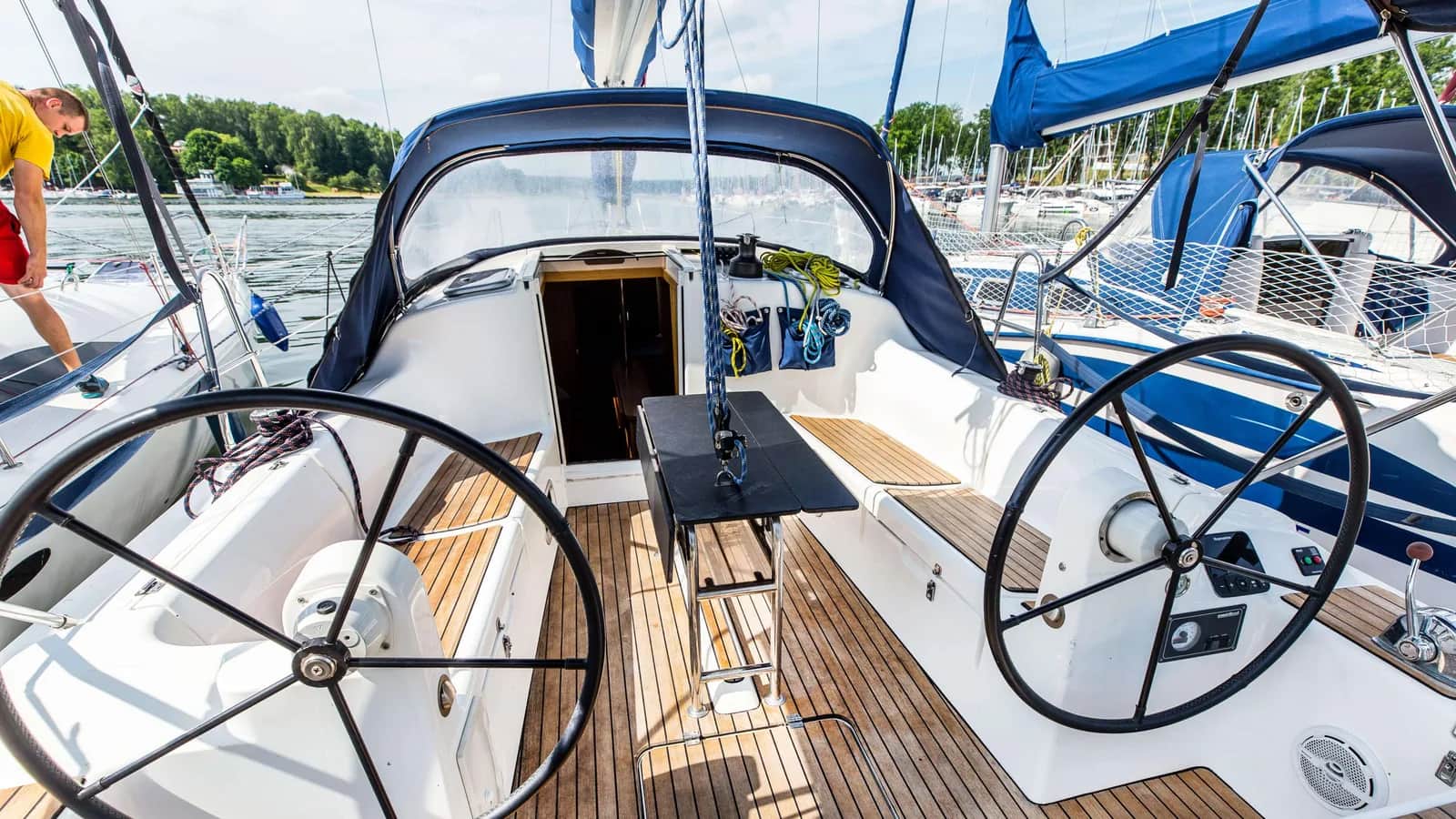
The rudder is the vertical plate at the stern that turns the yacht. You steer it either with a tiller (a bar in the cockpit) or with a steering wheel. In the listings on NaCzarter for the 2026 season, the dividing line falls at about 9 metres of hull length:
- sailboats up to 7.5 m: 14 out of 15 have a tiller,
- sailboats 7.5–9 m: 58 out of 68 have a tiller,
- yachts 9–10 m: 20 out of 22 have a steering wheel,
- yachts from 10 m: 20 out of 21 have a steering wheel.
The engine follows a similar pattern. Among sailboats up to 9 m almost all of them (82 out of 83) have an outboard engine hung on the stern. The median power is 6 HP, and half of them have between 5 and 10 HP. From 9 m upwards the inboard engine, tucked away inside the hull, takes over (33 out of 43), with a median of 21 HP. To see which types of boat sit behind these lengths, have a look at our overview of the types of yachts in Masuria.
What are the cockpit, companionway, grating, cockpit locker and cleat?
The cockpit is the sunken area for the crew in the aft part of the yacht. This is where you steer, and where everyone hangs out in the evening.
The companionway is the way down from the cockpit to below deck: a few steps and a sliding hatch. You close it for the night and when it rains.
The grating is a slatted wooden grid on the cockpit floor. Water drains underneath it and you do not slip on wet laminate. When the boatman says "the gratings stay in the cockpit", he is simply asking you not to carry them out onto the jetty.
The guardrail is the railing around the deck: stanchions and wires you hold on to as you walk to the bow. At the bow it usually starts with a steel pulpit.
A cleat is a metal fitting shaped like a pair of horns that you put the mooring line on. How to do it so nothing works loose at night is shown in the article cleats: what they are and how to moor.
A locker is a storage space under a seat or a berth. The cockpit lockers hold the fenders, spare lines, a bucket and everything else that should not be rolling around the deck.
At the stern there is also a swim ladder. 115 out of 126 sailboats listed on NaCzarter (2026 season) have one, so yours will most likely have it too. Still, check at handover that it can be lowered from the water, because that is what it is for.
Mast, boom, mainsail and jib: what is above the deck?
The main sail, the mainsail, is set on the mast, and its lower edge is held by a horizontal spar, the boom. Watch out for it when tacking and gybing, because it swings across the cockpit at head height. In front of the mast works the jib, a smaller sail. The mast is held up by steel wires: the forestay runs to the bow and the shrouds to the sides. On Masurian sailboats the mast can usually be lowered to get under a low bridge, and 87 out of 126 sailboats in the listings have a mast gantry for it to rest on when it is down. The ropes used to hoist and trim the sails have their own names (halyard, sheet and the rest), but that is a topic for a separate article: names of ropes on a yacht.
What are the kitchen, living room and bed called on a yacht?
The saloon is the main room below deck: a table with benches around it. During the day you eat here when it rains, and at night the saloon often turns into an extra berth once the table is lowered.
The galley is the yacht's kitchen. Usually a gas stove, a sink and often a fridge, squeezed into one counter next to the companionway. This is where you cook, not up on deck.
A berth is a bed on a yacht. There are berths in the bow, under the cockpit at the stern and in the saloon. The forward cabin is often triangular and narrower at the foot end, which matters if someone tall is sleeping there.
The toilet, known to sailors as the head, is either a marine toilet or a chemical one. You use it differently than at home, and the waste is emptied in the harbours. The details, including how much water you have in the tank, are in the article on the toilet and water on a charter yacht.
| Name | What it is | Where you will hear it in Masuria |
|---|---|---|
| Bow | front of the yacht | "go to the bow and take the line" |
| Stern | back of the yacht | "we're going in stern first to the jetty" |
| Side | side of the hull | "fenders over the side" |
| Port | left side, looking towards the bow | "the wind is on our port side" |
| Starboard | right side, looking towards the bow | "fenders on starboard" |
| Transom | flat rear wall of the hull | by the swim ladder and the outboard engine |
| Hull | the "shell" of the yacht | when scratches are noted in the handover report |
| Centreboard | retractable plate under the bottom | "raise the centreboard, it's getting shallow" |
| Fin keel | ballast under the hull | when you ask about the yacht's draught |
| Rudder | plate at the stern used to turn | "check that the rudder moves easily" |
| Tiller | steering bar | on sailboats up to about 9 m |
| Steering wheel | wheel used to steer | on larger yachts, from about 9 m |
| Cockpit | area for the crew and helmsman | "everyone into the cockpit, we're tacking" |
| Companionway | way down below deck | "close the companionway, it's going to rain" |
| Grating | slatted grid on the cockpit floor | at the yacht handover |
| Guardrail | railing around the deck | "hold the guardrail on your way to the bow" |
| Locker | storage under a seat or berth | "the fenders are in the locker" |
| Saloon | living area below deck | when making up the berths for the night |
| Galley | yacht kitchen | "who's on galley duty today?" |
| Berth | bed on a yacht | when sharing out the cabins on the first evening |
How do you remember these names on the first day of the trip?
The best way is hands on. At handover you walk around the yacht with the boatman and check the equipment against a list. That is a good moment to ask "and what is this called?" for every item. What exactly to check and what to put in the paperwork is described in the article on yacht handover and the handover report.
For port and starboard there is a simple trick, with no pretending it is an old sailing tradition: "port" and "left" both have four letters. Port is left, starboard is right. And port wine is red, just like the port navigation light.
To be honest: nobody will test you on this during a charter. It is enough to understand what the boatman and the skipper are saying, and if you hire a skipper for an extra fee, he will be doing most of the talking anyway. Some of the words will only stick after the trip, once you have taken the fenders out of the locker five times and tripped over the grating twice.
Frequently asked questions
What is the stern? The stern is the back part of a yacht or ship, the opposite of the bow. The stern carries the rudder, usually the engine and the cockpit, and in Masuria it is usually the stern that you bring up to the jetty.
Which side is port and which is starboard? Port is the left side and starboard is the right side, always looking from the stern towards the bow. The navigation light on the left is red, on the right it is green.
What is the kitchen on a yacht called? The kitchen on a yacht is the galley. On a charter sailboat it is usually a gas stove and a sink, often with a fridge as well.
What is the cockpit on a yacht? The cockpit is the sunken area in the aft part of the yacht where the crew sits and where you steer from. Under its seats there are storage spaces, the cockpit lockers.
What is the difference between a centreboard and a fin keel? A centreboard is a plate you raise into a case inside the hull, while a fin keel is heavy ballast under the hull, either fixed or retractable. Both stop the yacht from drifting sideways. In Masuria the underwater part can usually be raised, because the lakes can be shallow.
Cover photo: NaCzarter.pl