NaCzarter Team
· Updated
A cleat is an unassuming fitting that the whole business of mooring rests on — it is what you tie your yacht to the pontoon with, and what you make sheets and halyards fast on while sailing. Sounds trivial, yet a badly belayed line can shake loose at the first gust or — the opposite — jam so hard you cannot release it when you must do so fast. In this guide we explain what a cleat is, the types you will meet, and how to belay a line on a horn cleat step by step.
What a cleat is
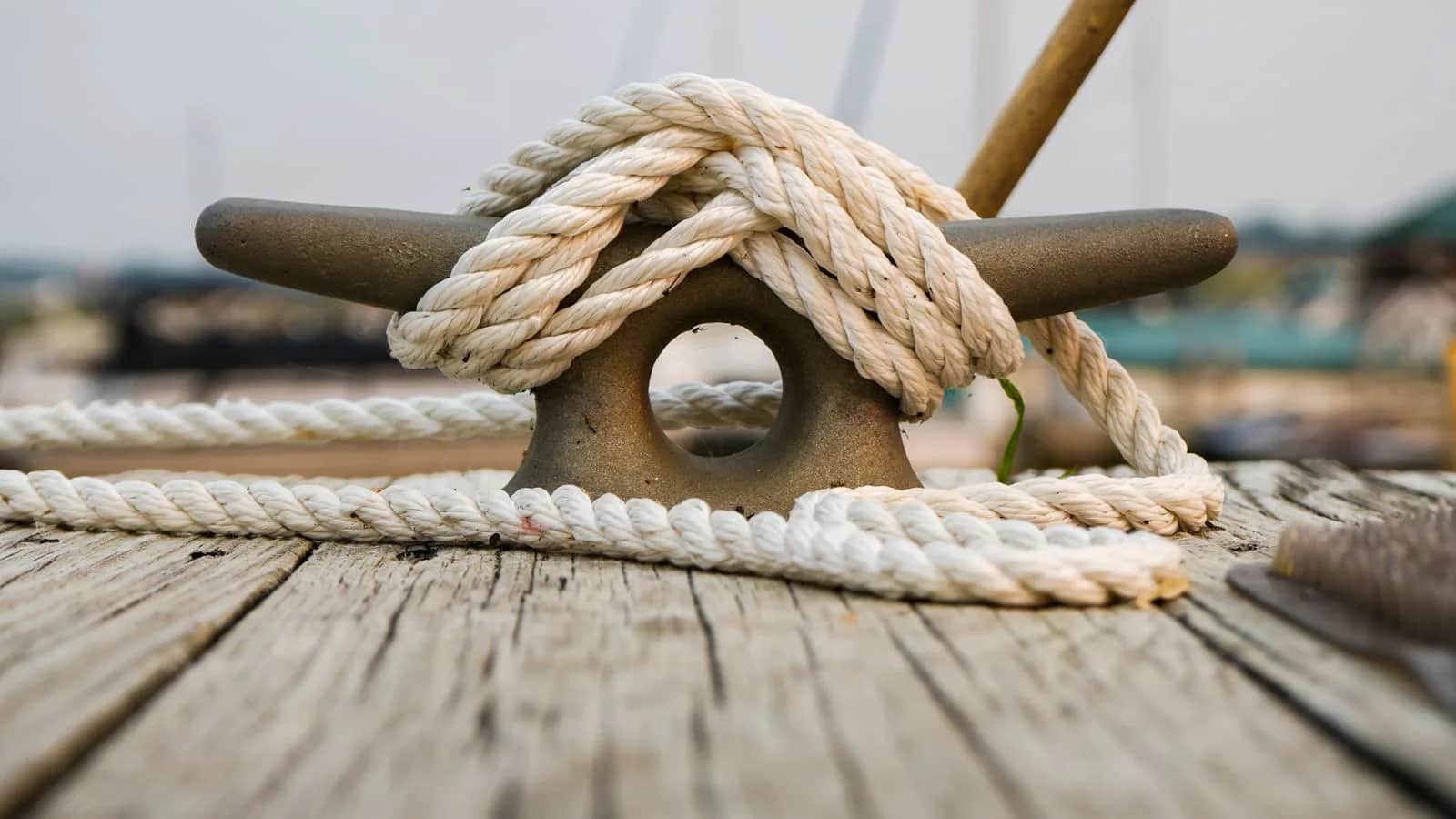
A cleat is a piece of deck hardware — a two-horned casting or forging — used to make a line fast quickly and securely, and to free it just as quickly. You will find it on a yacht's deck (for mooring lines, sheets and halyards), on the mast, and on the pontoon or quay in harbour. It is usually aluminium alloy, stainless steel or a strong polymer — what matters is that the cleat is sized to the line and to the loads it has to carry.
Types of cleat
In sailing you will meet several types, each for a slightly different job:
- Horn cleat (standard cleat) — the classic cleat with two horns. This is the one you belay mooring lines and halyards on in figure-eights. It holds firmly and predictably, but only if it is belayed correctly.
- Cam cleat — has two spring-loaded, toothed jaws that automatically grip a line pushed down between them. It blocks fast and releases fast, which is why it is favoured for sheets.
- Clam cleat (jam cleat) — a fixed body with a profiled, ribbed channel of tapering section that progressively grips the line. Simple, light and durable, because it has no moving parts.
Deck cleats (on the yacht) and pontoon cleats are spoken of separately — they differ in size, but you belay them the same way.
What cleats are for
On a yacht a cleat does three main jobs. First — mooring lines: the bow and stern cleats are what you make the boat fast to in harbour. Second — sheets: cam and clam cleats let you lock off a loaded sheet without tying a knot. Third — halyards: horn cleats on the mast hold a hoisted sail. On a pontoon or quay a cleat takes a thrown mooring line and holds the boat until the crew belays their own end aboard.
How to belay a line, step by step
The thing that really matters is belaying the line on a horn cleat correctly — the cleat hitch. Do it like this:
- Bring the line to the cleat from the side the load will come from, and take it first once fully around the base (the body) of the cleat — that full turn takes the main strain.
- Lead the line diagonally across the centre to the opposite horn and back, forming the characteristic figure-eight.
- Repeat the crossing figure-eights two, at most three times — each layer stacking on the last.
- Finish with a locking hitch: turn the free end into a loop so the slack part passes under the standing part, and drop it over a horn. Figure-eights without that locking turn can work loose over time.
A practical note: do not use the locking turn where the line must be released instantly under load — on a heavily loaded sheet the lock can jam so hard you cannot lift it off by hand. There a cam cleat, or plain figure-eights without the lock, serves better.
The most common mistakes
A few things worth remembering before you head out:
- Skipping the full turn around the base — without that first round turn the whole load goes straight into the figure-eights, which then shift and slip.
- Too many figure-eights — three layers are plenty; a heap of line only makes a fast release harder and looks untidy.
- Jamming a mooring line under load — if the line is heavily loaded, take the strain off it first (e.g. ease onto a second line) before trying to lift it off the cleat.
- Approaching from the wrong side — always lead the line so the load pulls along the cleat, not up and off it.
Belaying is one of those skills that become second nature after a few repetitions on a real deck. At NaCzarter you get a briefing and a mooring demonstration on your actual yacht before every cruise, and if you would rather learn by doing, you can sail with a skipper or start with a licence course. The rest is simply practice between the harbours of the Masurian Lakes.
Ready to cast off? See yacht rental in Masuria, the sailing-with-skipper option, or a sailing licence course.