NaCzarter Team
Can you handle marina maneuvers without the stress?
You can. The whole secret of harbour maneuvers is a plan made before the breakwater, the slowest speed you can manage, and a crew that knows its jobs before the boat slips in between the piers. Nothing more. Almost anyone can handle sails on a steady course. The nerves kick in at the harbour, because it's tight, the wind is blowing, and holidaymakers with ice cream are watching from the pier. After 25 years of handing over charter boats I've seen thousands of approaches, and one thing I know for sure: good maneuvers are boring. Slow, quiet and with no shouting.
If you're only just planning your first cruise, start with our first charter guide. Here we take on the harbour work itself — entering and leaving under engine, step by step.
Step 1: plan before the breakwater, not in the berth
The most common beginner mistake doesn't actually happen in the berth. It happens a moment earlier, when the boat enters the harbour with no plan. Before you pass the breakwater, slow down and answer three questions.
- Where is the wind coming from? Look at the flags, the water, the way other boats are lying.
- Where is a free spot and which way will you approach it?
- Which side will you come alongside on, and are you going in stern-first or bow-first?
You make the decision before you enter. In the berth it's too late for thinking — there you only execute the plan. If you can't spot a free place from a distance, motor slowly along the piers, have a look around the harbour and only then make your approach. Nobody is timing you.
Step 2: "as slow as possible, as fast as necessary"
An old rule, and it always works. Maneuvering speed is the lowest speed at which the boat still answers the helm. Slow means: you have time to react, to correct, to say a calm word to the crew. And if at that speed you touch the pier with a fender, nothing happened. Literally nothing.
I once watched a helmsman enter a berth at half throttle because "the wind was chasing him". He only stopped against his neighbour's hull. The same maneuver at idle revs would have ended with a gentle fender touch and a handshake on the pier. Use throttle in short bursts, only when you need steerage. Never constantly.
Step 3: the crew knows what to do before you go in
The briefing takes a moment and you do it on open water, not in the harbour entrance. Fenders out on the side you'll be berthing on. Mooring lines flaked out at the bow and stern, ready to pass. Everyone has one job and knows what it is. One person on the bow line, another on the stern line — that's enough.
And the most important thing: nobody jumps onto the pier. Ever. You pass the line to someone on the pier, or you step off calmly once the side is already against it. Jumping from a moving boat onto planks is the fastest way to an injury on the whole trip. And once the line reaches the pier, all it takes is a proper cleat hitch: we show how in our article on cleats.
Step 4: the wind rules, you make it work for you
A Masurian charter yacht is light. The wind pushes it sideways faster than intuition suggests, and the bow blows off before you can react. Don't fight it — use it. If you have the choice, approach into the wind: the wind brakes you for free, and often taking off the throttle is all it takes for the boat to settle exactly where you want it. An approach with the wind at your back is downhill driving with no brakes. Save those for when you've got some practice.
Step 5: reverse and prop walk
The propeller in reverse doesn't just brake. It also pulls the stern sideways — on a given boat, always to the same side. This is called prop walk, and it works a bit differently on every yacht. So on the first day of your charter, on calm water, run a simple test: stop the boat, put it in reverse and watch which way the stern goes. From that moment on you know, and you can play it. Come alongside on the side the prop pulls the stern towards, and reverse gear will tuck you against the pier by itself. Fighting prop walk is a losing game. Working with it is free help at every landing.
In the berth: piles or a mooring line, never your own anchor
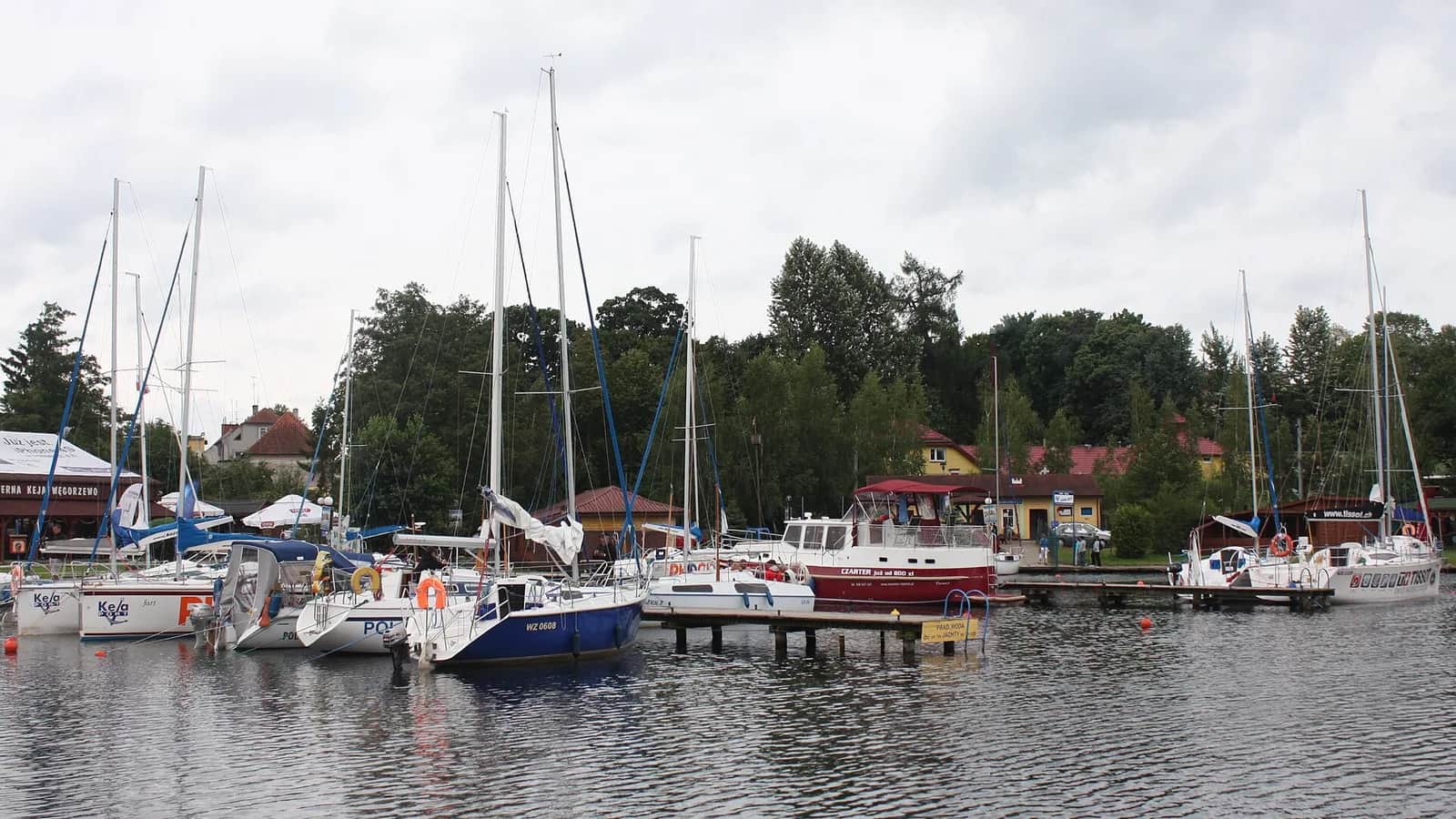
In Masurian harbours you lie perpendicular to the pier, on mooring piles (dolphins) or on a mooring line. The piles stand in front of the pier: you drop your lines over them on the way in, as you enter the berth, matching how you're lying — stern-to or bow-to. A mooring line runs from the bottom: you pick it up with the boathook at the stern, by the pier, and walk it forward to the bow. You don't drop your own anchor in a harbour. The anchor is for wild anchorages, which we cover in our anchoring guide.
Stern-to or bow-to? Whichever suits you and the berth. You take up exactly the same amount of space either way. Stern-to gives you easier access to the pier, bow-to gives you more privacy in the cockpit. We've laid out the whole stern-to approach in a separate piece: berthing stern-to, step by step.
Leaving the harbour: same plan, reverse order
You plan your departure the same way as your arrival: where the wind is coming from, which way you want to turn the boat, who does what. Take the lines off one by one, not all at once. The last one to go is the one holding the boat into the wind, because it keeps working until the very end. Cast it off too early and the wind will lay your bow on the neighbour before you've even started moving. When everything's ready, leave decisively, in one smooth move, without jerking the throttle. A moment of higher revs to get the boat moving, then back to slow.
Approach didn't work out? Circle round and try again
The best maneuver I saw last season was an aborted approach. The helmsman saw the wind pushing him onto the neighbouring yacht, calmly added throttle, went back out onto open water, made a circle and came in a second time — clean this time. Nobody laughed. A few old hands nodded in approval.
An aborted approach is professionalism, not embarrassment. The worst thing you can do is force a bad approach because "it's already started". On open water you have all the time in the world. In the berth you have seconds. The choice is simple.
Cheat sheet: five steps
| Step | What you do | Common mistake |
|---|---|---|
| Plan | Decide on the spot, the side and the approach direction before the breakwater | Going in "winging it" and hunting for a spot at the last moment |
| Speed | Idle revs, the minimum speed at which the boat still answers the helm | Half throttle "because the wind is chasing you" and braking against the pier |
| Crew | Fenders on the right side, lines flaked out, everyone knows their job | Last-second shouting and jumping onto the pier |
| Coming alongside | Approach into the wind, short bursts of throttle, line passed to the pier | Fighting the wind and prop walk instead of using them |
| Departure | Lines off one by one, the windward one last, a decisive exit | Letting everything go at once and drifting onto the neighbour |
Frequently asked questions
What do I do when a strong wind is blowing onto my beam? Approach with a margin on the windward side and let the wind push the boat into place by itself. If the harbour gives you a choice, take a berth you can approach into the wind. And when it's really blowing, ask someone on the pier for help. In Masuria that's completely normal — we do it ourselves.
Should I berth bow-to or stern-to? Whichever suits you and the berth. Perpendicular to the pier, exactly the same number of boats fit either way, whether you lie stern-to or bow-to. Stern-to makes getting ashore easier, bow-to can be easier to approach into the wind.
What do I do if the engine dies in the harbour? Nothing sudden. At maneuvering speed the boat drifts slowly — you have time. Put out the fenders, get a line ready and pass it to the pier, over a pile, or to someone on a neighbouring boat. You'll sort the engine out later. Panic breaks more things than a dead engine does.
Should I practise maneuvers before my first harbour entry? Yes. On day one, head out onto calm water and make a few approaches to a buoy or a free pier. Test reverse, prop walk and your boat's stopping distance. A short practice session saves your nerves for the whole cruise.
Cover photo: Ludwig Schneider — CC BY-SA 3.0, via Wikimedia Commons