NaCzarter Team
Stern-to mooring at a jetty in Masuria: how to do it step by step
Stern-to mooring (the so-called Mediterranean mooring, or in Masuria simply "stern to the jetty") is approaching the jetty with the back of the boat, with the bow held off the quay usually by mooring piles (Dalben) or a mooring line (you only drop your own anchor in wild spots), and running two stern lines onto the jetty. That is how you moor in tight harbours, because more boats fit perpendicular to the jetty than alongside. It sounds scary, but it is a matter of a few tries. Below I break it down into pieces so a beginner can handle it.
When do you moor stern-to at all
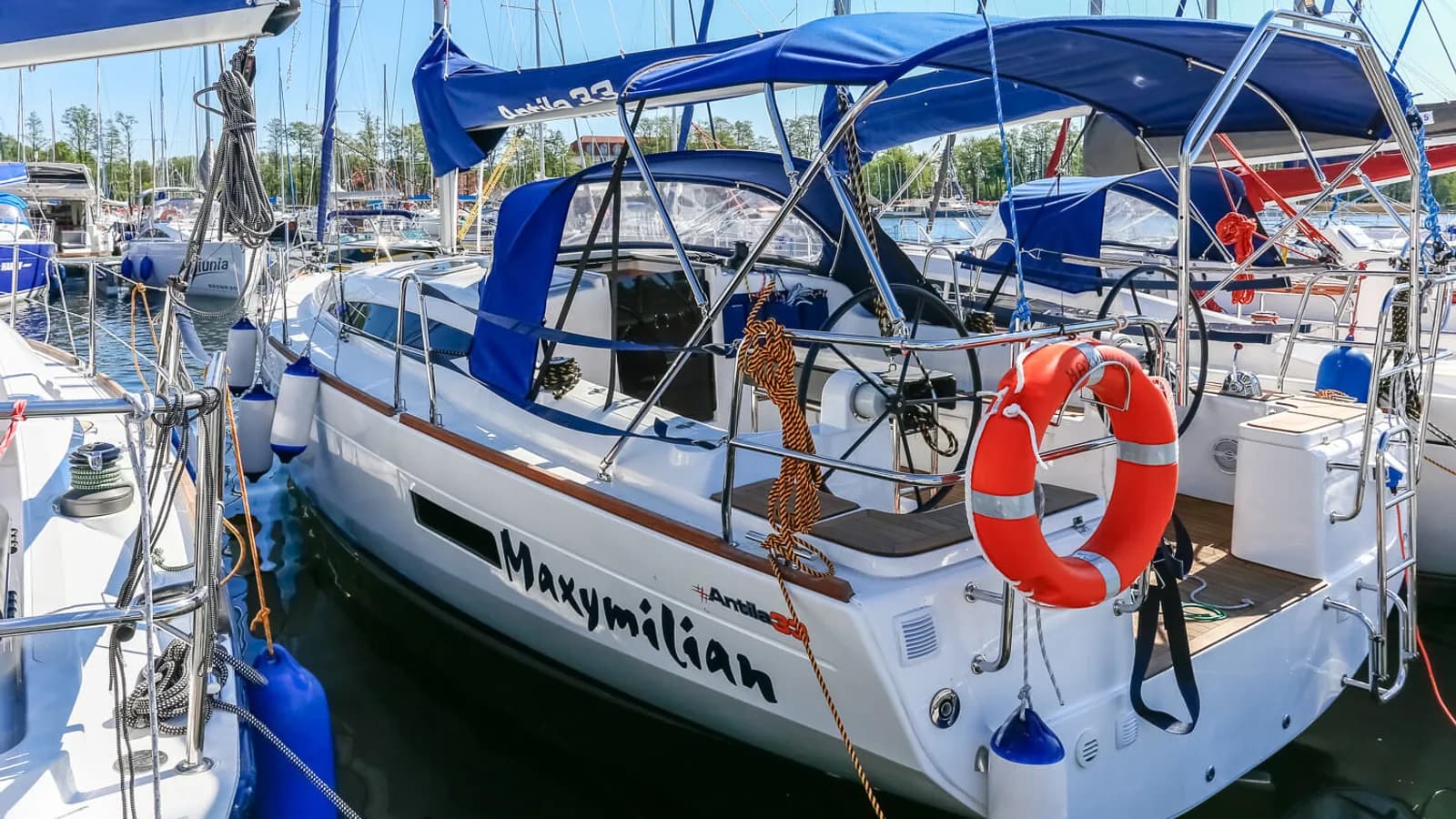
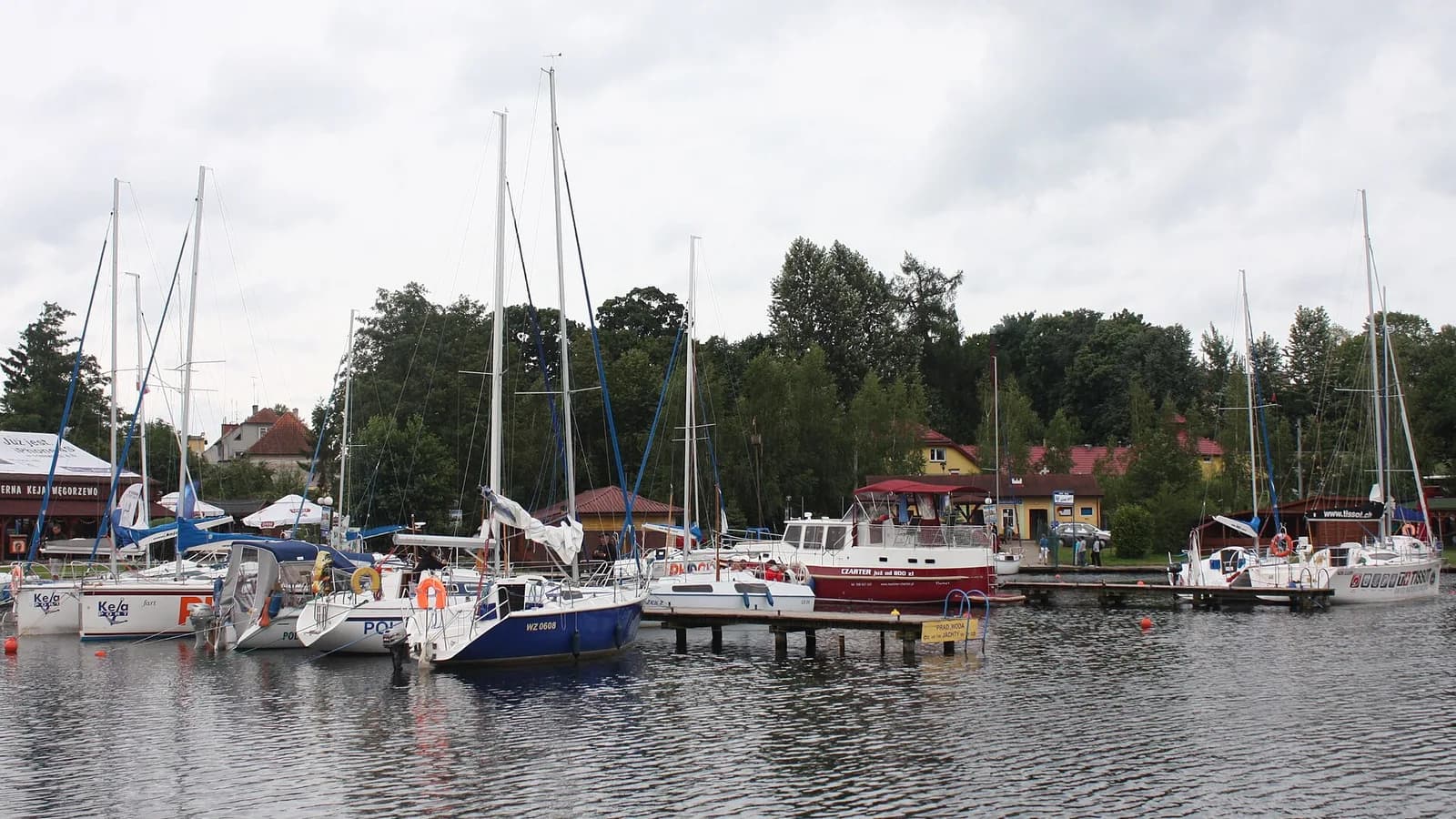
At the peak of the season, when harbours are bursting at the seams, the harbour master lines the boats up perpendicular to the jetty, because a lot more of them fit that way than alongside. But watch one thing: perpendicular fits the same number of boats whether they stand bow-in or stern-in. Stern-in is done for a different reason. First, it is easier to step ashore. One step from the transom onto the jetty and you are in the harbour. Bow-in, you would have to clamber over the guardrail. Second, you control the boat more easily, because the bow is held by mooring piles or a mooring line that pull you off the quay. That is why in Giżycko, Mikołajki or Węgorzewo in July and August you will most often hear from the harbour master: "come in stern first." We wrote more about where to even find a spot at peak season in the piece where to moor at peak season in Masuria.
What holds the bow off the jetty: mooring piles, a mooring line, more rarely your own anchor
In Masuria the bow is almost always held off the jetty by a mooring pile (Dalbe) or a mooring line. You don't drop your own anchor in a normal harbour. Check what a given harbour has before you approach, because the whole manoeuvre depends on it.
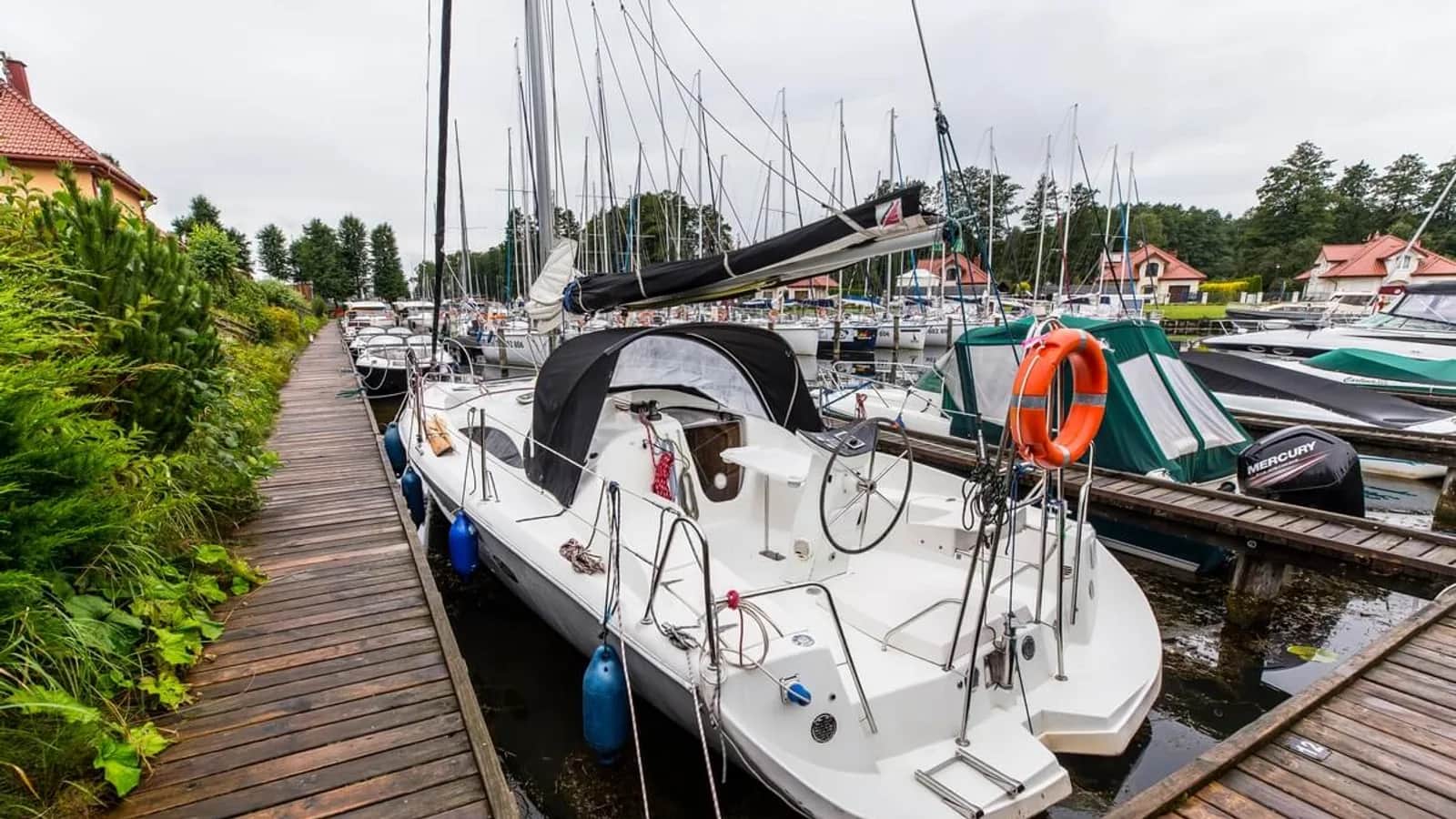
Mooring piles (Dalben). This is method number one in Masuria. Mooring piles are posts driven into the bottom a little way in front of the jetty. You come in stern first into the slot between two piles, throw your bow lines onto the piles (they hold the bow off the jetty), and lay the stern out onto the jetty. No anchor of your own, the piles do all the work and hold the bow rigidly. At our base, Port Royal in Giżycko, this is exactly how you moor.
Mooring line. A mooring line is a line lying on the bottom, with one end fixed at the jetty and the other to a weight or a chain resting on the bottom. Careful, because this is where beginners most often get lost. Once you come in stern first, you catch the mooring line with a boat hook at the jetty, that is from the stern side, where it is tied. Then you quickly walk that line along the deck to the bow and make it fast on the bow cleat. Then the mooring line pulls the bow off the jetty, exactly like a pile, only softly. Don't try to catch the mooring line from the bow, because it lies on the bottom and you won't reach it from the bow with any boat hook. You catch it from the stern, at the jetty, and carry it forward.
Your own anchor (only in the wild). In a wild corner, with no piles and no mooring line, you can hold the bow on your own anchor dropped from the bow during the approach. This is the hardest variant and you don't do it in a harbour with piles or a mooring line. I describe it separately below. On dropping and holding on an anchor we also have a guide: anchoring a yacht in Masuria.
The reality of Masuria: in developed marinas, like Giżycko, Mikołajki or Ekomarina Węgorzewo, there are almost always mooring piles or mooring lines (more rarely floating Y-booms, which hold you on both sides). You drop your own anchor stern-to more in wild coves than in a harbour.
The approach step by step
I describe the most common Masurian case, that is piles or a mooring line. The variant on your own anchor is below.
First, observation. Before you go in, look at where the wind is coming from and how the neighbours are lying. Pick a gap, and at piles a specific slot between two posts. Decide where the stern is to end up. Prepare the stern lines on both corners of the transom, bow lines ready to throw onto the piles, boat hook at hand in case of a mooring line, fenders on the sides. Split the roles in the crew: one at the bow with the bow lines and boat hook, one or two at the stern with the lines.
Then you approach. You line the boat up bow away from the jetty, straight in front of your gap. You stop, put it in reverse and start backing slowly, straight into the spot. Working astern is the hardest part, because in reverse the stern of the boat runs off to the side (the propeller effect, so-called prop-walk), and the rudder holds poorly at low speed. So back with a small but distinct speed, so the rudder bites the water.
Use the propeller effect to your advantage. Do a test on open water and check which way your boat throws its stern in reverse. Then choose the approach side so that the prop-walk helps bring the stern into place. And if mid-manoeuvre you want to kick the stern to the side, don't count on the rudder alone, because in reverse it barely works. The real tool is a short burst forward with the rudder laid over to the side: the propeller wash kicks the stern sideways, and then you put it back in reverse.
You hold the bow off the jetty as soon as the stern reaches the quay. At piles, the person at the bow throws the bow lines onto the posts on both sides, even before the stern reaches the jetty. With a mooring line, you bring the stern up to the jetty, catch the mooring line with a boat hook at the jetty, carry it along the deck to the bow and make it fast on the bow cleat. In both cases it is about the same thing: the bow must be pulled off the quay before you deal with the stern.
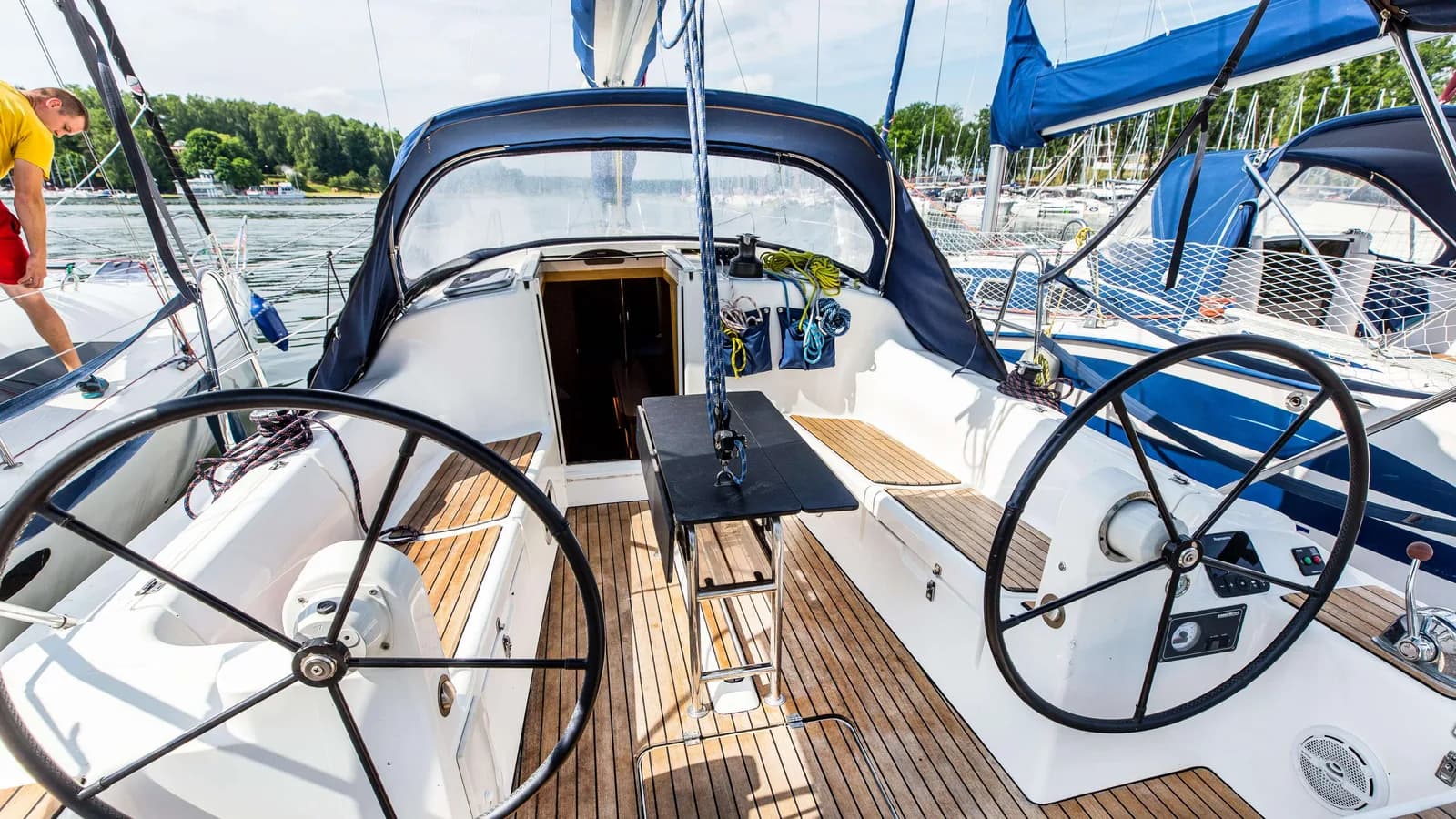
Finally you pass the stern lines. When the transom is a metre or two from the jetty, the person at the stern passes or throws a line to someone on the jetty (or steps off themselves, if it is close). Lead each line to a jetty cleat slightly outboard of your transom corner. Then the two form a shallow V, they are spread apart and block the stern from swinging sideways. In a very tight spot you can cross them, that is left corner to the right cleat and vice versa. You make both stern lines fast, then take up the bow lines on the piles or the mooring line so that the boat stands in a straddle: the tensioned bow pulls forward, the tensioned lines pull the stern, and the boat hangs between them and doesn't bang against the jetty. How to tie off on a cleat without a mistake, we laid out here: a cleat, what it is and how to moor.
One warning at the end. When working astern and when leaving, make sure a loose stern line, an anchor line or someone else's mooring line doesn't get sucked under the transom into the propeller. Especially when you give it throttle. First take up the slack in the lines, only then manoeuvre.
| Step | What you do |
|---|---|
| 1. Recon | You check the wind direction, the free gap, the slot between the piles, how the neighbours are lying. You mark the spot for the stern. |
| 2. Preparation | Stern lines on the transom corners, bow lines ready for the piles, boat hook at hand for the mooring line, fenders on both sides, crew at their stations. |
| 3. Setup | Bow away from the jetty, straight in front of the gap, with plenty of distance to the quay. |
| 4. Working astern | Reverse, back slowly but distinctly, correct with the rudder and use the prop-walk under control. |
| 5. Bow off the jetty | At piles you throw the bow lines onto the posts. With a mooring line you catch it with a boat hook at the jetty and carry it to the bow. |
| 6. Stern lines | You pass two lines to the jetty cleats, slightly outboard of the transom corners, so they form a shallow V. |
| 7. Trimming out | You tension the bow (piles or mooring line) and the stern lines so the boat hangs between them and doesn't bang. |
Variant: your own anchor in a wild corner
You only do this where there are no piles and no mooring line, for example at a wild jetty with no gear or on an anchor in a cove. In a harbour with piles or a mooring line you don't drop your own anchor, because you will only make a mess on the bottom and snag other people's lines.
You drop the anchor early. That is, when the bow and the whole boat are still far off, roughly about two hull lengths from the spot where the stern is to end up (in shallow Masuria there is no point going further out). Then you back and pay out the line, so the anchor digs into the bottom before the stern reaches the jetty. Take a scope of line of roughly three to five times the water depth, in shallow Masuria that usually works out to a dozen or so metres. Before you bring the stern up to the jetty, put a light load on the anchor, that is a moment of reverse with the line tensioned, and check that it holds. Only then pass the stern lines. The rest of the manoeuvre is the same as with piles: two stern lines in a shallow V, and at the end trimming out, so that the tensioned anchor line pulls the bow and the lines pull the stern.
Wind and neighbours
Wind is the main factor in this manoeuvre and it acts differently depending on where it comes from. It is worth recognising three cases.
From the side, wind setting you down. This is the main enemy. When it blows from the side, the boat drifts down onto the neighbour before you manage to pass the lines. Advice: come in with a slight correction into the wind, that is aim the stern a bit up into the wind, so the drift brings you exactly onto the spot. Back a touch faster then, so the rudder has power and the wind doesn't manage to blow you off. When it blows hard, don't be shy about adding a few revs for a moment to catch the heading.
From the bow, wind pushing you on. An easier case, because the wind pushes you onto the jetty by itself. Come in slower than usual and watch that you don't hit the quay with the stern. Have the lines ready right away, to slow the approach before the transom bumps the jetty.
From the stern, wind pushing you off. The hardest. The wind pushes the bow off the jetty, so the bow falls off to leeward. Here the piles or the mooring line save you, holding the bow. Back with more power, and have the stern lines ready for instant passing, because otherwise the bow will run off to the side before you manage to tie up.
Neighbours are the second issue. Have fenders on both sides, not just one. If you see you are drifting onto someone else's boat, it is better to pull off, do a loop and approach again, than to force your way in and scratch the gelcoat on two boats. Nobody will judge you for a second approach. For a dented guardrail on the neighbour, they will.
Good practice: if there are people in the harbour, ask someone on the jetty to take a line. The harbour master or a neighbour will usually help. That is normal, that is how you moor in every Masurian harbour.
The most common beginner mistakes
Dropping your own anchor in a harbour with piles. A classic. Since there are piles or a mooring line, use them. Your own anchor in a harbour only gets in the way and picks up other people's lines in a tangle.
Catching the mooring line from the bow. The mooring line lies on the bottom and you won't reach it from the bow with any boat hook. You catch it from the stern, at the jetty, and only then carry it to the bow.
Working astern too slowly. People are afraid of speed and back so slowly that the rudder doesn't work and the boat does what it likes. Paradoxically, a bit more speed gives you more control.
A loose line under the propeller. Before you add throttle, take up the slack in the lines and watch the anchor line and someone else's mooring line, so nothing gets sucked under the transom into the propeller.
No division of roles. When everyone on deck does everything and nothing, the manoeuvre falls apart. Settle it beforehand: who is at the bow, who is on the stern lines, who steers.
Panic when drifting. When the wind pushes the boat down, beginners freeze. It is better to pull off and approach a second time than to sit there and watch yourself drift onto the neighbour.
Frequently asked questions
Why do you moor stern-to rather than bow-to? It is not about space, because perpendicular to the jetty the same number of boats fit whether they stand bow-in or stern-in. Stern-in is done because it is more comfortable to step ashore from the transom, and the boat is easier to control, because the bow is held by piles or a mooring line that pull it off the quay. At peak season the harbour masters line the boats up perpendicular so the harbour holds everyone, and most often exactly stern-to.
What holds the bow off the jetty in Masuria? Almost always mooring piles or a mooring line. Piles are posts in front of the jetty onto which you throw the bow lines. A mooring line is a line lying on the bottom that you catch with a boat hook at the jetty and carry to the bow. You only drop your own anchor in wild spots without piles and mooring lines, because in a normal harbour it is unnecessary and gets in the neighbours' way.
How do you catch the mooring line when mooring stern-to? The mooring line lies on the bottom and is fixed by one end at the jetty. You come in stern first, catch it with a boat hook from the stern, exactly where it is tied to the jetty. Then you walk the line along the deck to the bow and make it fast on the bow cleat. Don't try to catch the mooring line from the bow, because it lies on the bottom and you won't reach it from the front.
When do you drop your own anchor if there are no piles or mooring line? Early. You drop it when the boat is still far off, roughly two hull lengths from the spot where the stern is to end up. Then you back and pay out the line, so the anchor digs into the bottom before the stern reaches the jetty. Before you pass the lines, take a moment of reverse with the line tensioned and check that the anchor holds. In a harbour with piles or a mooring line you don't do this.
What do you do when it blows from the side? Aim the stern a bit up into the wind, so the drift brings you exactly onto the spot, and back a touch faster, so the rudder has power. If you still drift onto the neighbour, pull off and approach again instead of forcing your way in. When the wind blows from the stern and pushes you off the jetty, lean on the piles or the mooring line, which hold the bow, and have the stern lines ready for instant passing.
Is stern-to mooring hard for a beginner? At first, yes, because working astern and a side wind take a feel for it. But it is a matter of a few tries. Split the roles in the crew, have fenders on both sides and don't be afraid of a second approach. After a few goes it becomes second nature.
Cover photo: NaCzarter.pl