NaCzarter Team
Man overboard is the one situation on a yacht where every single second truly counts — no exceptions, not even on a seemingly calm Masurian lake. Plenty of sailors think of the MOB manoeuvre (short for man overboard) as something reserved for offshore blue-water passages, when in fact the most dangerous incidents tend to happen close to shore, on a warm day, in a deceptively gentle breeze. Someone leans out to grab a mooring line, the yacht jerks on the wake of a passing motorboat, a second's inattention — and there's a person in the water. The good news is that a slick rescue manoeuvre is no magic trick; it's a sequence of simple actions you can drill and commit to memory. In this guide we walk through the entire MOB step by step: what you do in the first five seconds, how to return under sail, how to approach under engine, how to haul someone back on board, and what to keep in mind specifically on the Masurian Lakes.
Man overboard — why seconds count (on a lake too)
Once a person is in the water, you lose sight of them faster than intuition suggests. A head on the surface of a lake is a small, dark dot that vanishes behind every wave and every metre the yacht pulls away. In a Force 3–4 breeze, a sailing boat moves away from the casualty at several metres per second — after twenty seconds you're already tens of metres apart, and there's nothing left for the eye to lock onto. That's why the first rule of MOB is this: never put any action off "until later." What you do in those first moments decides whether you'll have anyone left to rescue at all.
On the Masurian Lakes there's a second factor at play — water temperature. Even in July the lake can be below twenty degrees, and in spring and autumn far colder. Cold water means thermal shock in the first seconds (an involuntary gasp underwater, hyperventilation, panic) and creeping hypothermia in the minutes that follow, sapping the strength in the arms and the ability to help themselves. A person who would normally climb the boarding ladder unaided may, after a few minutes in cold water, be unable to hold on to a line at all. That's why we measure the manoeuvre in minutes, not quarter-hours — and why we treat our weather and safety guide for the Masurian Lakes as required reading before you ever cast off from the quay.
The first five seconds — what you do immediately (shout, spotter, ring/buoy)
The whole effectiveness of MOB rests on three reflexes that have to happen at once and in a flash. There's no time for a discussion here — every crew member knows in advance what they do.
- A loud shout of "MAN OVERBOARD!" — this isn't melodrama, it's the alarm signal that puts the whole crew on their feet and tells the helm we're switching into rescue mode. Anyone who sees it happen shouts it.
- Appointing a SPOTTER — one person gets one job: never take their eyes off the person in the water and keep pointing at them with an outstretched arm. Nothing else — no coiling lines, no helping with the sails, no reaching for a phone. Their arm is the compass by which the helm brings the yacht back. This is the single most important role on board at that moment.
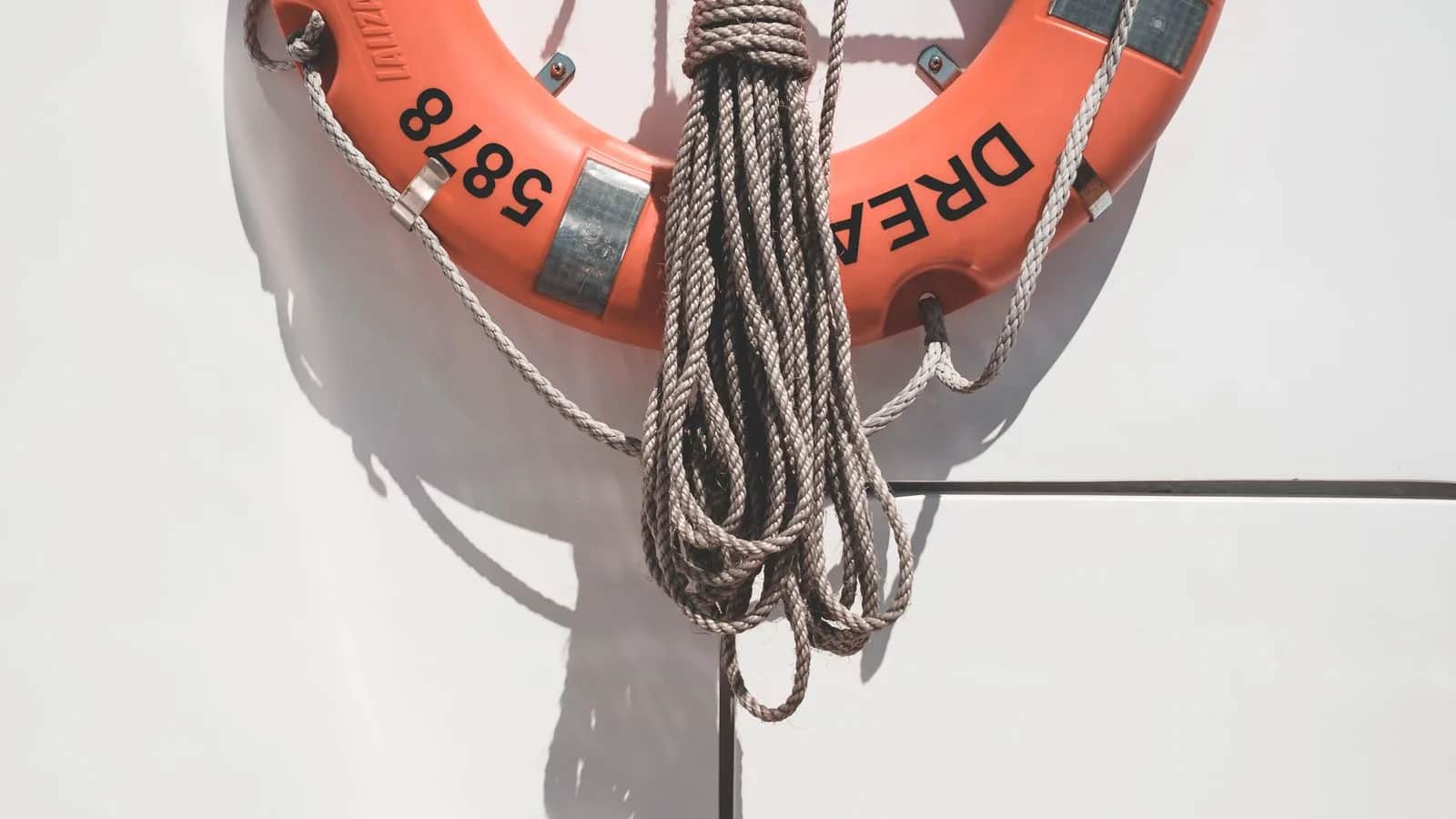
- Throwing something that floats — a lifebuoy, an MOB dan buoy, or as a last resort anything that will stay on the surface. It serves two purposes: giving the casualty something to hold on to and marking the spot. Throw it immediately, even if the person still seems to be swimming under their own steam — because in ten seconds that may no longer be the case.
You'll find the definition and the classic description of the manoeuvre in the man overboard entry on Wikipedia — worth reading calmly before a cruise, so the sequence pops into your head on its own when there's no time to think. If the yacht has a modern chartplotter with an MOB function, pressing the "overboard" button will save the GPS position — but even then a living spotter with an outstretched arm remains more valuable than a dot on a screen.
Returning under sail — step by step (the tack back / the "figure of eight")
The classic sailing manoeuvre has a single aim: to bring the yacht to a stop head to wind, just to windward of the casualty, so that the yacht drifts down onto them from windward. In other words — we want to come to rest alongside the person "in the lee" of the yacht, sails flogging, with no drive, rather than bearing down on them under full sail.
Two variants are most commonly taught. The first is the "figure of eight": as soon as the person goes overboard, you bear away onto a beam reach (to build up distance and room for the manoeuvre), and after a few boat lengths you tack and come back hard on the wind, aiming to approach the casualty from the windward side and lose your way head to wind right beside them. The yacht's track traces a figure of eight in the water — hence the name. The second variant is the quick tack back (usually onto starboard): almost immediately after the incident you tack and, after a short arc, return to the person. It's faster, but it takes practice to judge where you'll lose your way.
A few things that are easy to forget in the heat of the moment:
- Always come up fully into the wind — it's the wind that brings the yacht to a halt when you ease the sheets. Approaching downwind means you have no way to stop and you'll simply sail on past.
- In the final metres, ease the sheets and let the sails flog — the yacht should stop, not bear down. The mainsail and jib flap, and your speed drops to zero exactly at the person.
- Stay in contact with the spotter — it's their arm that tells you where the target is, especially when wave and sun make it hard to pick out a head in the water.
On a cruising yacht you rarely stick to one "pure" textbook version. In practice on the Masurian Lakes you usually combine sail with engine — more on that shortly. If you're still learning to handle a yacht, it's worth starting with our first charter guide, where we cover the basics of handling the boat before you start drilling rescue manoeuvres.
Under engine — how to approach safely and never forget the propeller
On a modern Masurian charter yacht the engine is your ally — it gives you full control over the approach regardless of wind direction. But the engine also means a turning propeller, and that is a real, serious danger to a person in the water. That's why the engine manoeuvre has its own iron rules.
- Approach slowly — the closer you get, the less throttle. You want to reach them at walking pace, ready to stop the yacht at any instant, not to "lunge" at them and shoot past.
- The person MUST be on the side where you can keep them in sight to the very end — plan the approach so the casualty never ends up under the bow or behind the stern, where you lose sight of them and where the propeller is. You normally approach so as to keep them alongside, within the helm's line of sight.
- Always take the engine out of gear (and ideally switch it off) at the topsides — the moment the person is alongside the hull and you begin recovery, the propeller must be still. This isn't optional or a "just in case" — it's a safety requirement. Slipping into neutral and killing the drive before the casualty comes within reach of the topsides protects them from the worst.
On the Masurian Lakes the engine is especially valuable in a short, steep chop and gusty wind, when a purely sailing manoeuvre is risky. There's nothing wrong with closing the distance under sail and making the final approach under engine with the sails loose — provided you remember the propeller.
Recovering the person from the water — from leeward, how to haul them aboard
Bringing the yacht to the person is only half the battle. The other half — often the harder one — is getting them out of the water. We always do this from the leeward side: the yacht then drifts towards the person rather than pushing away from them, and the topsides are lower and sheltered from the waves.
The recovery sequence looks roughly like this:
- Contact — first you make physical contact: pass a boathook, throw a heaving line (a line with a float) or lower the boarding ladder. The point is to stop them drifting away from the yacht and to give them something to hold on to.
- Securing with a line — you tie or clip the casualty to the yacht with a line before you start hauling. That way, if they weaken during recovery, they won't slip back into the water.
- Hauling — from the leeward side, ideally with several people. Here's something few people remember: a person in hypothermia may not be able to help. Chilled hands won't grip the rungs of a ladder, and a chilled body has no strength left to pull itself up. That's why you should plan a "horizontal" lift — positioning the body more parallel to the water's surface rather than a vertical hoist. Use the ladder, a bight of line under the buttocks, or as a last resort the main halyard or a tackle. For a large person against a low freeboard, a simple "yank upwards" just won't work.
It's worth deciding in advance who on your yacht is responsible for recovery and what gear you have — a stern ladder can be impractical in a swell, and a boathook and heaving line should be within reach, not buried in a locker.
The specifics of the Masurian Lakes — cold water, squalls, crowds, children aboard
The MOB manoeuvre is universal, but the Masurian waters impose a few conditions of their own that simply can't be ignored.
Cold water. This is the most commonly underestimated danger. Hypothermia sets in faster than the summery air on deck suggests — cold water draws heat away several times faster than air at the same temperature. A person who fell into the lake in a T-shirt may be on the edge of being unable to help within a few minutes. This is an argument not only for a fast manoeuvre, but also for the fact that a life jacket on deck dramatically improves the odds — it keeps the head above water even when the person is losing strength.
Squalls and short waves. The Masurian Lakes are famous for sudden, violent changes in weather. A white squall can arrive within minutes out of a clear sky, and it's precisely in such conditions that the risk of going overboard is greatest — and the manoeuvre hardest. A short, steep chop makes both the approach and picking out a head in the water more difficult. If you're not familiar with the phenomenon, be sure to read our piece on the white squall on the Masurian Lakes — because the best MOB is the one you managed to avoid by getting the crew below before the front arrived.
Crowds. At the peak of the season, in the narrows and by the locks, the water can be busy. This is both a cause of incidents (wake from passing craft, nervous manoeuvres) and a complication in a rescue — you have to turn back for the person while dodging others. All the more reason to have a well-drilled routine, so the manoeuvre comes off smoothly and predictably.
Children aboard. The Masurian Lakes are a paradise for family cruising, but a child overboard is a scenario you need to have thought through before it happens. Children should wear their life jackets at all times when on deck, and an adult should be given the role of "eyes" on the youngest. A small person cools down faster and is harder to spot in the water.
How to drill MOB with your crew — practice at the start of the cruise
The biggest secret of an effective manoeuvre is that in a real situation it isn't theory that works — it's routine. Nobody has time to recall "what the manual said" when the seconds are ticking away. That's why the best skippers do one simple thing: they drill MOB with their crew at the start of the cruise, before anything has even happened.
The drill is dead simple. You throw something buoyant overboard — an ordinary dan buoy, a fender on a line, anything clearly visible that stands in for a person — and the whole crew runs through the return and "recovery" manoeuvre. Everyone gets their role: who shouts, who becomes the spotter, who throws the lifebuoy, who works the sheets, who does the recovery. After one or two run-throughs the sequence gets into your blood, and you know whether your particular crew can cope on this particular yacht. It's also the moment to check where the rescue gear is stowed and whether the ladder actually works.
If you feel that rescue manoeuvres are a bit much for you right now — or you simply want to relax with an expert on board — a good solution is a skippered charter. An experienced skipper not only takes responsibility for safety, but will also show you the manoeuvre in practice, so that on your next cruise you can do it yourselves. Over 25 years on the Masurian market, we've seen that this is often the best start for less experienced crews.
Prevention — life jackets, safety harnesses and rules on deck
The best MOB manoeuvre is the one you never have to perform. The whole philosophy of safety on board comes down to keeping a person out of the water in the first place — and if they do go in, making sure they survive the first seconds and stay on the surface.
- Buoyancy aids and life jackets — worn, not stowed. A life jacket lying in a locker will save no one. You can read about how they work and how the various types of lifesaving devices differ in the life jacket entry. On the Masurian Lakes a healthy habit is life jackets on children at all times, and on adults — always in bad weather, at night and during manoeuvres.
- Safety harnesses and jackstays. In bad weather and at night it's worth clipping on with a harness to the safety lines rigged along the deck. Then, even after a slip, the person stays with the yacht rather than going overboard.
- The "one hand for yourself" rule. When moving about the deck, always hold on to something with one hand. It's the oldest piece of sailing wisdom and still one of the most effective.
- Extra care with children. A designated adult, life jackets worn at all times, clear rules for moving about the deck.
We've gathered a complete list of what's worth bringing along — from life jackets to small safety gear — in our guide on what to pack for a charter. It's also worth remembering that the authority on sailing training and safety in Poland is the Polish Yachting Association — if you want to build your skills systematically, it's a good point of reference.
Frequently asked questions
Is the MOB manoeuvre really necessary on the calm Masurian lakes? Yes, and more than you might think — most dangerous incidents happen close to shore, in good weather, when vigilance is at its lowest. Cold water and rapid hypothermia mean that even on a lake seconds count, and a well-executed manoeuvre saves lives.
Should I return to the person under sail or under engine? On a charter yacht you usually combine the two — you close the distance under sail, and the final approach is often made under engine for full control. The key rule with the engine: take it out of gear or switch it off before the person is alongside, so the propeller is no threat.
How do you haul aboard someone who has run out of strength? Approach from the leeward side, first make contact (boathook, heaving line, ladder) and secure the person with a line, then haul them in — ideally "horizontally," because someone in hypothermia may not be able to pull themselves up or hold on to a ladder.
Plan a safe cruise on the Masurian Lakes
Safety starts with a good yacht, sound equipment and a well-thought-out plan — and it all begins with a booking. At NaCzarter you'll find trusted boats with complete rescue equipment and, if you need one, a skipper to show you the MOB manoeuvre in practice. Check availability and book online: yacht rental on the Masurian Lakes — and out on the water, focus on nothing but calm, mindful sailing.