NaCzarter Team
· Updated
When to lower the centreboard and when to raise it
Lower the centreboard close-hauled and on a beam reach, so the boat holds course instead of sliding sideways. Downwind, raise it partly. It goes fully up over shallows, at the beach and in port, wherever the water is shallower than the draught with the board down. For the Antila 33 that is 0.45 m board up and 1.80 m board down.
Centreboard, lifting keel, fixed keel: what sits under the hull
Masurian yachts mostly have a centreboard or a lifting keel. The fixed keel known from the sea is rare here: the lakes are shallow and the harbours shallower still. On charter you will meet three designs:
- Pivoting centreboard (Antila 24, 27, 28.2, 30, 33). The plate swings on a pin in the centreboard case. You raise it with a line through a tackle to a winch, or a winch handle. On hitting the bottom it may kick up by itself: it works like a pendulum.
- Lifting keel (Maxus 33.1 RS, Twister 32). It moves vertically in a trunk. Same lateral resistance as a centreboard, but it will not give way on a rock: it takes the hit head-on. The Maxus keel also carries ballast, so raising it costs the boat part of its stability. Call it a keel, not a centreboard: it is a different design.
- Fixed fins (Twister 36). Nothing to raise, draught from 0.55 to 0.75 m. Simple, but you get only as far into the shallows as the hull allows.
A centreboard or lifting keel gives you two boats in one: deep under sail, shallow near the shore. In return, one more thing to watch. How board, keel and ballast affect stability is in our article on whether a sailing yacht can capsize. Here we cover only when to move the board. Torn between two popular models? The comparison Antila 33 or Maxus 33.1 RS will help you decide.
When the centreboard should be down
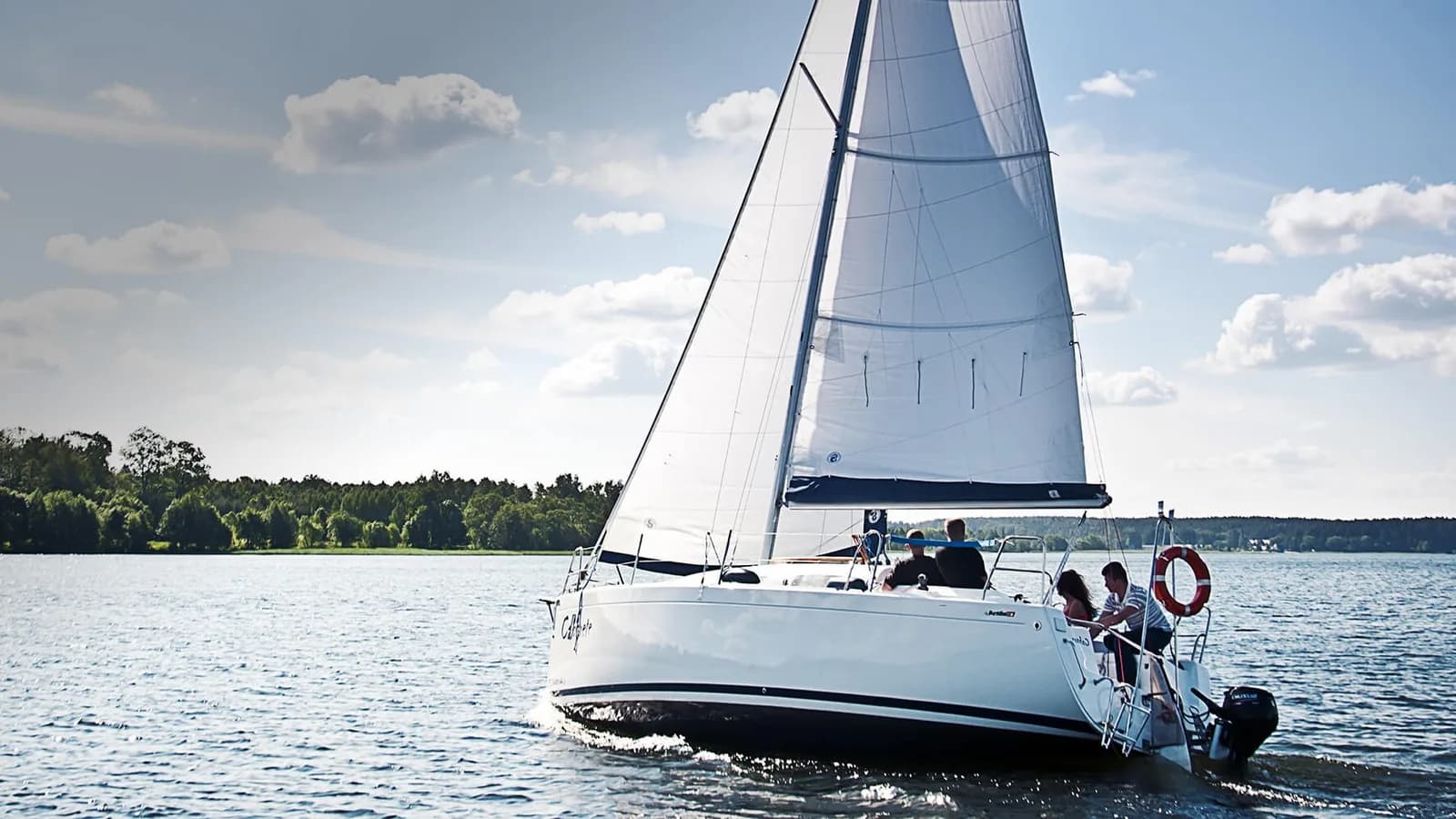
The closer to the wind, the more board in the water. Close-hauled and on a beam reach, lower it fully. The board provides lateral resistance; without it the boat slides sideways instead of going where the bow points, and the helm goes soft. Beating upwind with the board up is mostly leeway and frayed nerves.
Leave it down in three more situations:
- In waves. In stronger wind Śniardwy and Mamry build a short, steep chop. With the board down the boat rolls less and holds course better. Raising it then is asking for trouble.
- During manoeuvres under sail. Tacking with the board up often fails: the boat loses speed, stalls head to wind and will not come round. Before giving the command, check the board is down. The technique is in our text on tacking and gybing.
- When approaching a buoy or someone who has fallen overboard. You need a boat that answers the helm.
When the centreboard goes up
Downwind, from a broad reach to a dead run, the board matters less: the wind pushes more from behind than from the side. Partly raised, it reduces drag and the boat speeds up. On a pivoting centreboard the raised plate swings aft, so the boat also carries less weather helm. "Partly" is the important word: fully up, the boat yaws and answers the helm slowly. So leave some board in the water, especially in stronger wind.
The board goes fully up where depth counts, not sails:
- Shallows and shoals. Śniardwy is wide and shallow, with rocky patches near the shores and around the islands. Bays and reed beds along the whole route hide the bottom closer than the open water suggests. Heading for the shore? Board up, and a crew member on the bow watching the water.
- Approaching a jetty and in port. Water by jetties is often shallow and the bottom not always clean. Raise the board before entering harbour; while mooring you have no hands free. In a deep harbour leave it a little in the water: under engine with the board fully up, a side wind sets the boat off more.
- Canals. Between lakes you motor, so the board does nothing but risk snagging. Raise it at the entrance, lower it after the exit when you set sail again.
- Beach and anchorage in a bay. You anchor for the night in a sheltered bay off the fairway. Raise the board on the way in. Once anchored, lower it a little if depth allows: with board in the water the boat swings less at its line.
How to handle it on a charter
Every boat has a different mechanism, so the first question at handover is: "How do you raise the centreboard and where is the lock?" Depending on the model it is a line through a tackle to a winch, a winch handle or an electric drive. Ask to be shown the full cycle: down, up, lock. Ask too whether an intermediate position is allowed and how to secure it.
A few rules that save nerves and money:
- Raise and lower without jerking. The board is heavy: line on the winch, steady motion. If something resists, do not add force; find what is blocking it.
- Do not raise it fully in waves. The boat will start rolling and yawing. A locked intermediate position does the job.
- Listen. A half-raised, unlocked board knocks in its case with every heel. That sound says: lock it or lower it fully.
- After hitting the bottom return to deeper water and check that the board moves both ways and no water is gathering in the bilge. Then call the owner, even if all looks fine. Reporting at once costs less than a discovery at check-in.
- Board jammed? Most often a pebble, silt or reed stalks got between board and case after a trip into the reeds. Gently lower and raise it a few times, move to deeper water and repeat. Do not hammer anything or force it with the winch. If it will not budge, call the owner: they know their boat.
Draught with the centreboard raised and lowered
The table gives the hull's draught with the centreboard or keel raised and lowered. Write the figures on a card by the helm: near the shore use the raised column, under sail the lowered one.
| Model | What you raise | Draught, raised | Draught, lowered |
|---|---|---|---|
| Antila 24 | centreboard | 0.35 m | 1.38 m |
| Antila 26 cc | centreboard | 0.39 m | 1.62 m |
| Antila 27 | centreboard | 0.39 m | 1.65 m |
| Antila 28.2 | centreboard | 0.43 m | 1.75 m |
| Antila 30 | centreboard | 0.44 m | 1.79 m |
| Antila 33 | centreboard | 0.45 m | 1.80 m |
| Twister 32 | lifting keel | 0.50 m | 1.65 m |
| Maxus 33.1 RS | lifting keel | 0.45 m | 1.70 m |
| What it means | the centreboard pivots, the keel moves vertically | minimum water by the reeds or at a shallow jetty, add a margin | the water you need on a close-hauled course, plus a margin for waves |
Data: manufacturers' specifications (2026). A loaded boat sits a little deeper. Dates and charter prices for the Antila 33 from owners on the NaCzarter platform: see the Antila 33 charter page.
Frequently asked questions
Can you sail with the centreboard raised? Under engine, yes. Under sail downwind, yes, but only partly raised. Close-hauled, no: the boat makes leeway and tacks fail.
Does the centreboard protect against capsizing? Ballast and hull shape do that; the centreboard mainly governs course and leeway. What this means for a centreboard yacht and one with a ballasted lifting keel is in the capsizing article linked above.
What about the keel on the Maxus 33.1 RS? Same rules: down close-hauled, up over shallows. The keel will not swing back on impact like a pivoting centreboard, so raise it earlier. It also carries ballast, so with the keel up the boat is less stable and you do not sail like that in strong wind.
What happens if the centreboard hits a rock? Most often nothing but a grey hair, sometimes a damaged board or case. Report it to the owner at once, do not wait for check-in. Crew-caused damage is settled by the owner from the refundable deposit, paid and settled on site under the charter contract.
How much water under the keel do I need? The draught at the current board position, plus a margin for waves and misjudgement. Approaching the shore, raise the board and use the "raised" column of the table. Where the wish "feet of water under the keel" comes from, we explain separately.
Cover photo: NaCzarter.pl