NaCzarter Team
Tacking — How to Sail Upwind (A Beginner's Guide)
The first thing that surprises a beginner chartering in Masuria: a sailboat will not sail straight toward the source of the wind. When the harbour, or the cove you have your eye on, lies dead to windward, you have to steer the bow in a "zigzag." This technique is called tacking, and it is what turns an awkward wind into an ally. After 25 years of taking crews across the Masurian lakes, we know that once it finally "clicks," sailing becomes genuinely rewarding.
The no-go zone — why you can't sail straight into the wind
Around the direction the wind blows from there is a so-called no-go zone (dead angle). When you point the bow too close to the wind line, the sails stop working and simply flap, while the yacht loses speed and stalls. In practice an inland sailboat will not sail closer than roughly 40–50° to the wind line — meaning about 45° on each side stays a zone you cannot enter. The exact figure depends on the yacht's design, its sails, the wind strength and the waves (light racing centreboarders can get down to around 40°, while a typical charter yacht keeps a more sensible margin). The tightest course on which the sails still pull is close-hauled — "hard on the wind."
Tacking step by step
Since you cannot sail straight into the wind, you head for your destination alternately on port and starboard tack — hence the zigzag. A tack is the side the wind meets the sails: when it blows over the port side, you are on port tack; when it comes over the starboard side, you are on starboard tack. You change tack by coming about, a manoeuvre in which the bow passes through the wind line. The routine is simple:
- Set the yacht close-hauled and build up speed — that speed is the "fuel" for getting through the dead angle.
- Perform the coming-about manoeuvre crisply, so the bow passes quickly through the wind.
- On the new tack, point up to close-hauled again and sail toward your goal.
- Keep repeating the turns so that each leg brings you closer to a point lying to windward.
Pointing up, bearing away and choosing your tacking angle
Pointing up means changing course closer to the wind line (toward close-hauled); bearing away means moving away from it (toward the fuller courses). When you are beating to windward you balance between the two: sail too tight and you slip into a flapping sail and lose speed; bear away too far and you add distance. The sweet spot is the tightest course on which the sails still work at full power. You match the length of your legs to the water: on a narrow lake you tack more often, on open water less. It is worth knowing that coming about is done heading into the wind, while its opposite, the gybe (turning downwind), is performed when the wind blows from astern. To find your bearings in all of this, the wind rose and directions will help.
Common beginner mistakes
- Too hard on the wind — the bow enters the dead angle, the sails flap and the yacht "sits down." Bear away slightly until the sails fill and work again.
- Tacking without speed — the yacht fails to pass through the wind line and stalls in the dead angle, "in the eye of the wind." Always build up speed before the turn.
- Legs that are too flat — if you don't point up, every leg leads sideways rather than toward your goal. Hold close-hauled.
On the calm Masurian lakes you will learn to tack in a single afternoon. If you would like to practise on an easy-to-handle yacht, take a look at our fleet on the sailing yachts Masuria page, or book a cruise straight away under yacht rental Masuria. And one more thing: keep an eye on the sky — you can read about sudden changes in the weather in our guide to the white squall on the Masurian Lakes.
Frequently asked questions
What is tacking in sailing? It is a way of sailing upwind in a "zigzag" — a series of turns coming about, alternating between port and starboard tack, that let you reach a destination lying exactly where the wind blows from.
At what angle can a sailboat sail to the wind? At best about 40–50° to the wind line, that is, close-hauled. Closer to the wind lies the no-go zone, where the sails only flap and the yacht loses speed.
How does coming about differ from a gybe? When coming about, the bow passes through the wind line (you sail upwind, tacking), whereas in a gybe it is the stern that passes through the wind line — and that manoeuvre is used on downwind courses.
Why does my yacht stall during a turn? Most often because you went into the turn without speed and the yacht got stuck in the dead angle, "in the eye of the wind." Build up speed close-hauled and carry out the turn decisively.
Does tacking take long to learn? No — you will grasp the basics in a single afternoon on a calm lake. In Masuria the conditions are beginner-friendly, and an easy-to-handle yacht makes learning easier still.
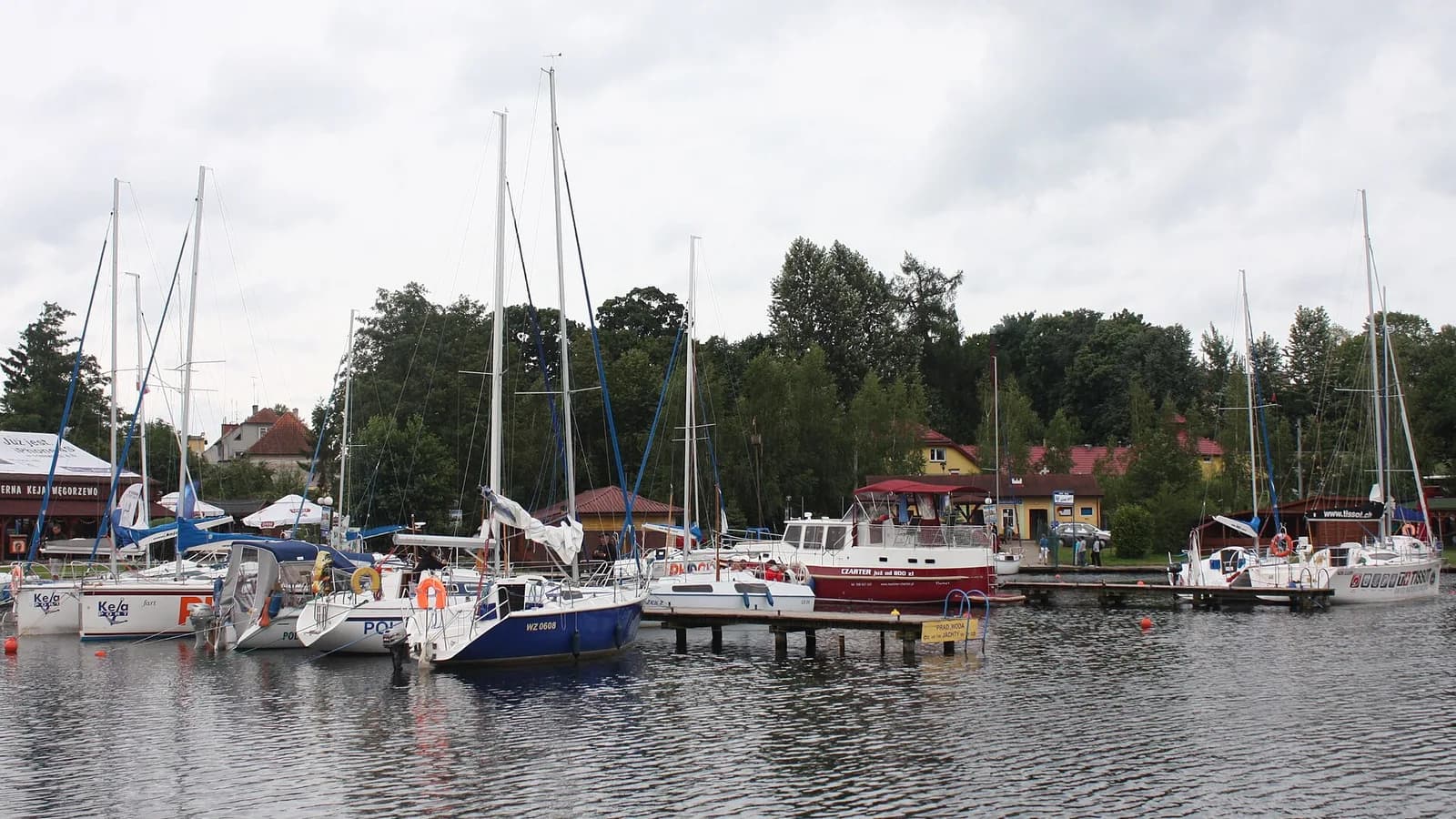
Cover photo: Arnas Goldberg / Wikimedia Commons (CC BY 3.0).