NaCzarter Team
What does "feet of water under the keel" mean?
"Feet of water under the keel" (in Polish "stopy wody pod kilem") is a sailors' wish for a good voyage: may there always be water to spare beneath the hull, and may the yacht never run aground. One foot is 30.48 cm. The Great Dictionary of the Polish Language (WSJP) published by the Polish Academy of Sciences lists it as a courtesy phrase. People say it instead of "good luck", often together with "fair winds".
The dictionary records it as an exclamation marked "sailing" and defines it briefly as a formula wishing someone a successful voyage, addressed to sailors. It is not a technical term, just a courtesy, like saying "enjoy your meal" at the table. Among the typical combinations, WSJP gives "to wish someone feet of water under the keel" and "feet of water under the keel and fair winds". One of its examples comes from the newspaper "Dziennik Bałtycki" in 1999: "We wish the crew of the Nauticus feet of water under the keel and fair winds".
Where do you hear it? When a crew is seen off as they push away from the jetty. At the opening of the season, when the club commodore says a few words before the first sail. The dictionary has an example of that too, from "Tygodnik Podhalański". Add to that a card for someone who has just passed their sailing exam, or a text from friends who know your trip starts on Saturday.
In Masuria it usually goes like this. Saturday morning, a harbour, someone on the jetty calls out to a departing crew: "Feet of water under the keel!". Everyone waves and nobody gives it much thought. In the afternoon the same crew turns into a reedy bay for the night and suddenly feels the centreboard scraping the bottom. That is when it sinks in that the phrase was not just poetry.
How much is a foot of water?
A foot is 30.48 cm. Since an international agreement in 1959 it has been exactly 0.3048 m. Taken literally, "feet" in the plural means at least two, so roughly 61 cm of clearance between the keel and the bottom. Not much, but enough to get through safely.
Another nautical unit linked to the foot is the fathom. It equals 6 feet, or 1.8288 m. Depths on nautical charts used to be given in fathoms, and the lines of sounding leads, used to measure depth on the go, were marked in fathoms. That is what we know about the units. Where the phrase itself came from, the dictionary does not say, so you will not find any legend about its origins here.
In Masuria, though, depth is measured in metres anyway. Metres are used on the charts, in navigation notices and for the draft listed in a yacht's description. Here the foot lives on mainly in good wishes.
Why can this wish be literal in Masuria?
For many people it is just a polite formula. On the Masurian lakes and canals it is a very practical matter.
We looked at the draft of the sailboats listed on NaCzarter for the 2026 season (125 yachts from 16 owners). With the centreboard or fin raised, a yacht draws 0.3–0.7 m, with a median of 0.4 m. With it lowered, half of the listings draw 1.5–1.8 m, and the median is 1.7 m. You will find the exact figure for a given boat in its description when you browse sailing yachts in Masuria.
Wody Polskie (the Regional Water Management Authority in Białystok), in Navigation Notice no. 2/2026 of 21 April 2026, gives transit depths for the waterways of the Great Masurian Lakes of 1.50 m for class Ia and 2.20 m for class II. These values apply at low water, meaning a reading of 89 cm on the water gauge in Giżycko. Compare that with the draft: a lowered centreboard can reach deeper than the transit depth of the shallowest waterway class. And outside the fairway, nobody publishes any depths at all.
In practice it works like this: in canals, when approaching the reeds and anywhere it gets shallow, the centreboard goes up. Shallow spots are marked by poles and signs, which we cover in our article on waterway markings in Masuria. If you plan to spend the night in a small bay, read our guide to mooring in the wild as well, because approaching the reeds is different from coming alongside a jetty. And when heading for the shore, it helps to know how to anchor a yacht in Masuria.
Better to raise the centreboard a minute too early than a metre too late.
When do you wish someone feet of water under the keel, and what should you not say?
Most often before setting off: on the jetty when saying goodbye, or in the last message before the trip. The other typical moment is the opening and closing of the season at sailing clubs, when the wishes go out to the whole group at once. It also works well on a congratulations card after a passed sailing exam.
You do not say "good luck" to a sailor, because among people of the water it is considered a wish that brings bad luck. We have collected more customs like this in our article on sailing superstitions.
How do you reply to "feet of water under the keel"?
There is no fixed formula, and there is no point inventing one. On the jetty a simple "thanks" is enough, or "same to you" if the other person is heading out too. You can also return the favour and add "and fair winds".
Sailing wishes tend to stick together into longer sets anyway. One of the examples quoted by WSJP (from "Dziennik Polski", 2001) reads: "Feet of water under the keel, fair winds and always a happy return to port". If you want to reply more festively, feel free to borrow it.
What other sailing wishes and greetings are there?
Fair winds. WSJP records "fair winds" in the sense of "favourable conditions". Sailors are wished them before a voyage, often together with feet of water under the keel.
A happy return to port. A wish that the trip ends without mishaps and everyone comes back safe. It fits a farewell, especially before a longer passage.
Wind in your sails. Said to a sailor, it is meant literally: may the wind blow just right. Away from the water it works figuratively. The dictionary knows the phrase "to catch the wind in your sails", meaning to make use of favourable circumstances and get going with energy.
Ahoy. According to the PWN Polish dictionary, "ahoj" is "a greeting, welcome or farewell used most often among seamen and sailors". The PWN spelling dictionary writes it with an exclamation mark: "ahoj!". In Masuria you hear it when boats pass each other on the water and on the jetty.
| Wish or greeting | What it means | When it is said |
|---|---|---|
| Feet of water under the keel | a wish for a good voyage, free of shallows | before setting off, as a farewell, at the opening of the season |
| Fair winds | favourable conditions | before a voyage, often together with feet of water |
| A happy return to port | that everyone comes back safe | as a farewell, before a longer passage |
| Wind in your sails | a good wind, figuratively momentum in what you do | literally to sailors, figuratively away from the water |
| Ahoy! | a greeting, welcome or farewell | when passing on the water, on the jetty |
Frequently asked questions
What does "feet of water under the keel" mean? It is a sailors' wish for a good voyage. The WSJP dictionary of the Polish Academy of Sciences defines it as a formula wishing a successful voyage, addressed to sailors. Literally, it means there should always be enough water under the hull so the yacht does not run aground.
How do you reply when someone wishes you feet of water under the keel? There is no single traditional reply to "feet of water under the keel". A "thanks", "same to you" or "and fair winds" is enough.
Why don't you say "good luck" to sailors? It is one of the sailing superstitions: "good luck" is considered a wish that brings bad luck. That is why people say "feet of water under the keel" instead.
How much is a foot of water under the keel in centimetres? One foot is 30.48 cm. In Masuria this is a real margin: a sailboat with its centreboard lowered usually draws 1.5–1.8 m, and Wody Polskie gives transit depths of 1.50 m and 2.20 m at low water for the local waterways, depending on the class.
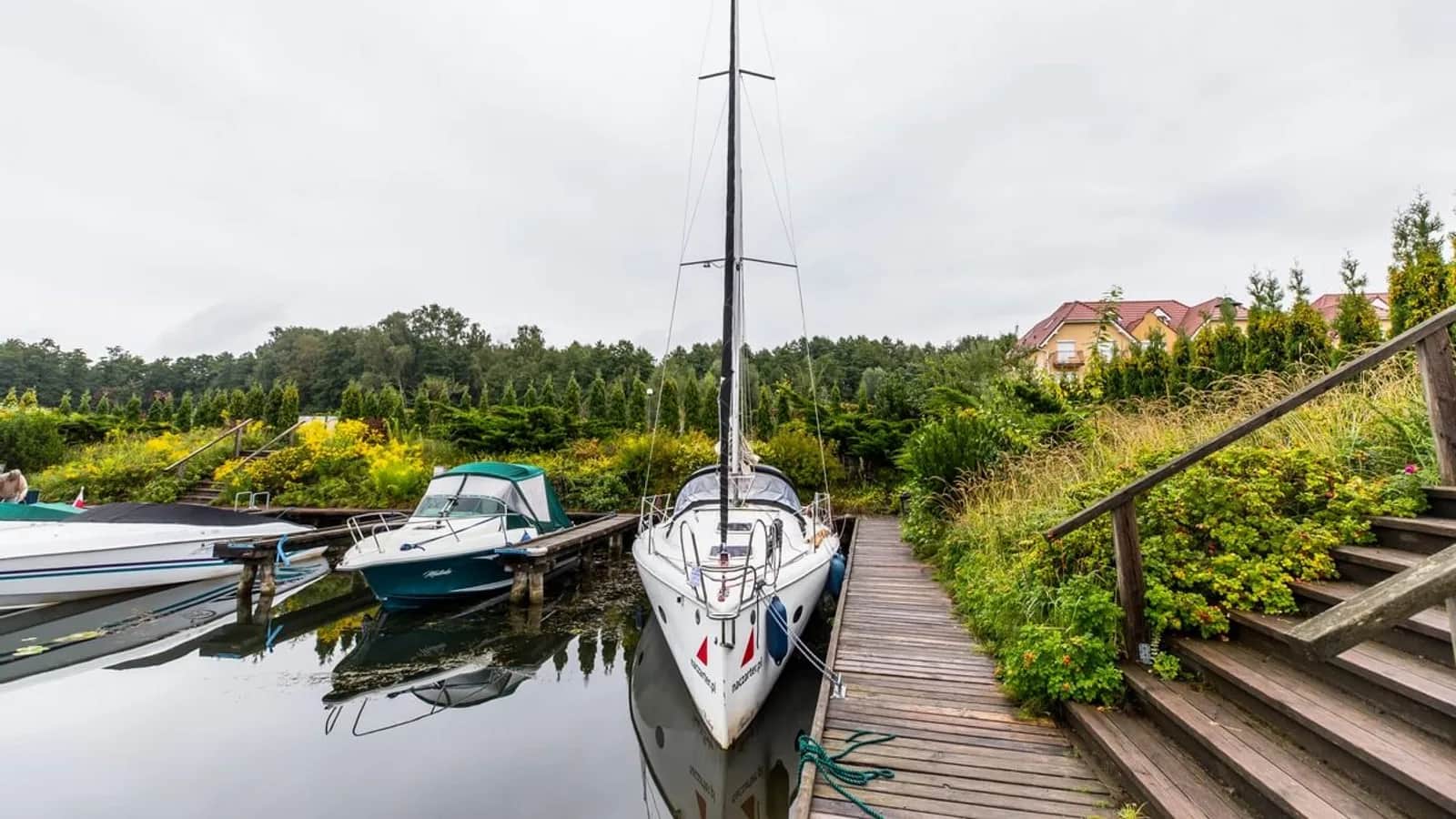
Cover photo: NaCzarter.pl