NaCzarter Team
· Updated
How many sails a charter yacht has, and their names
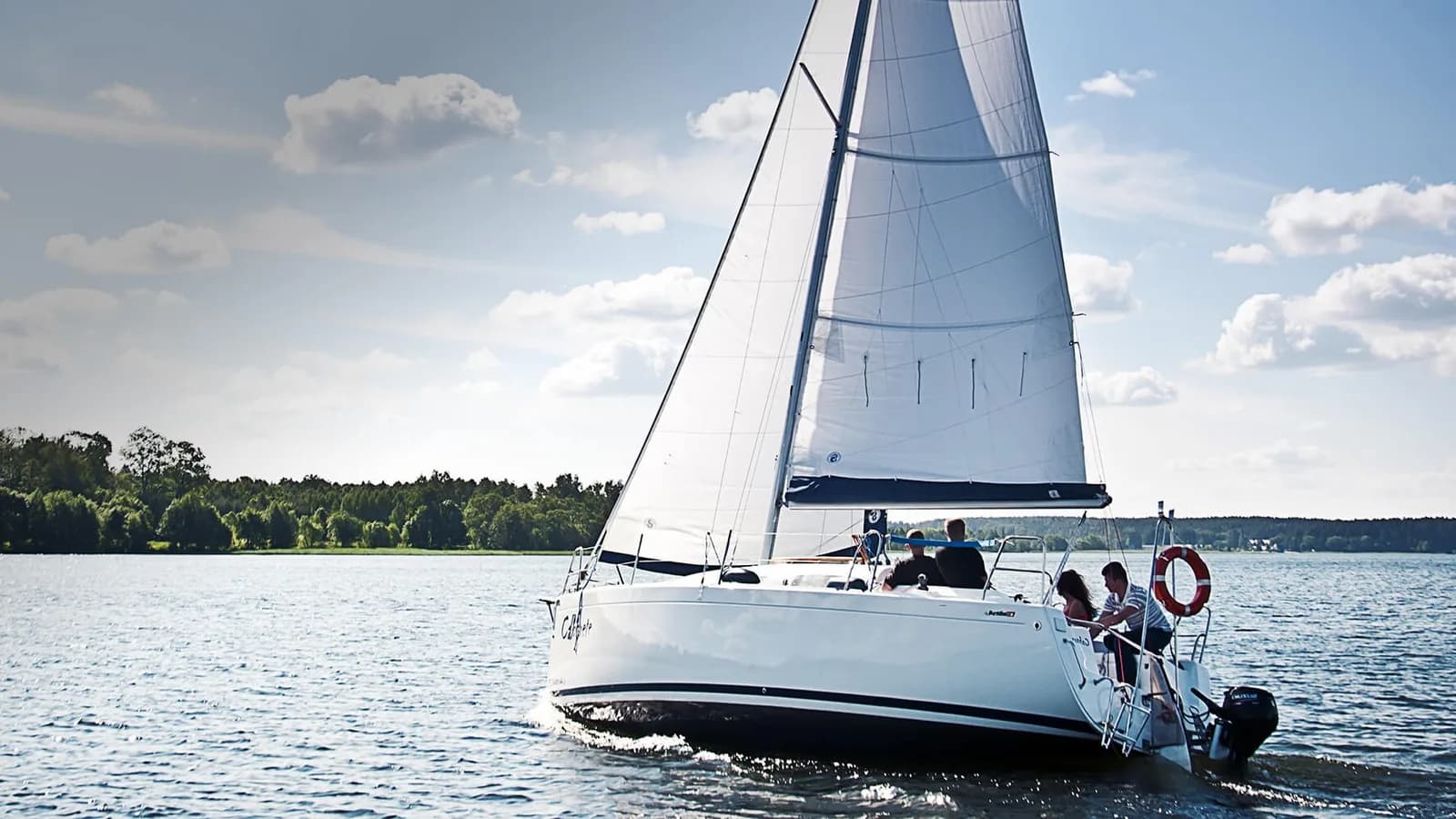
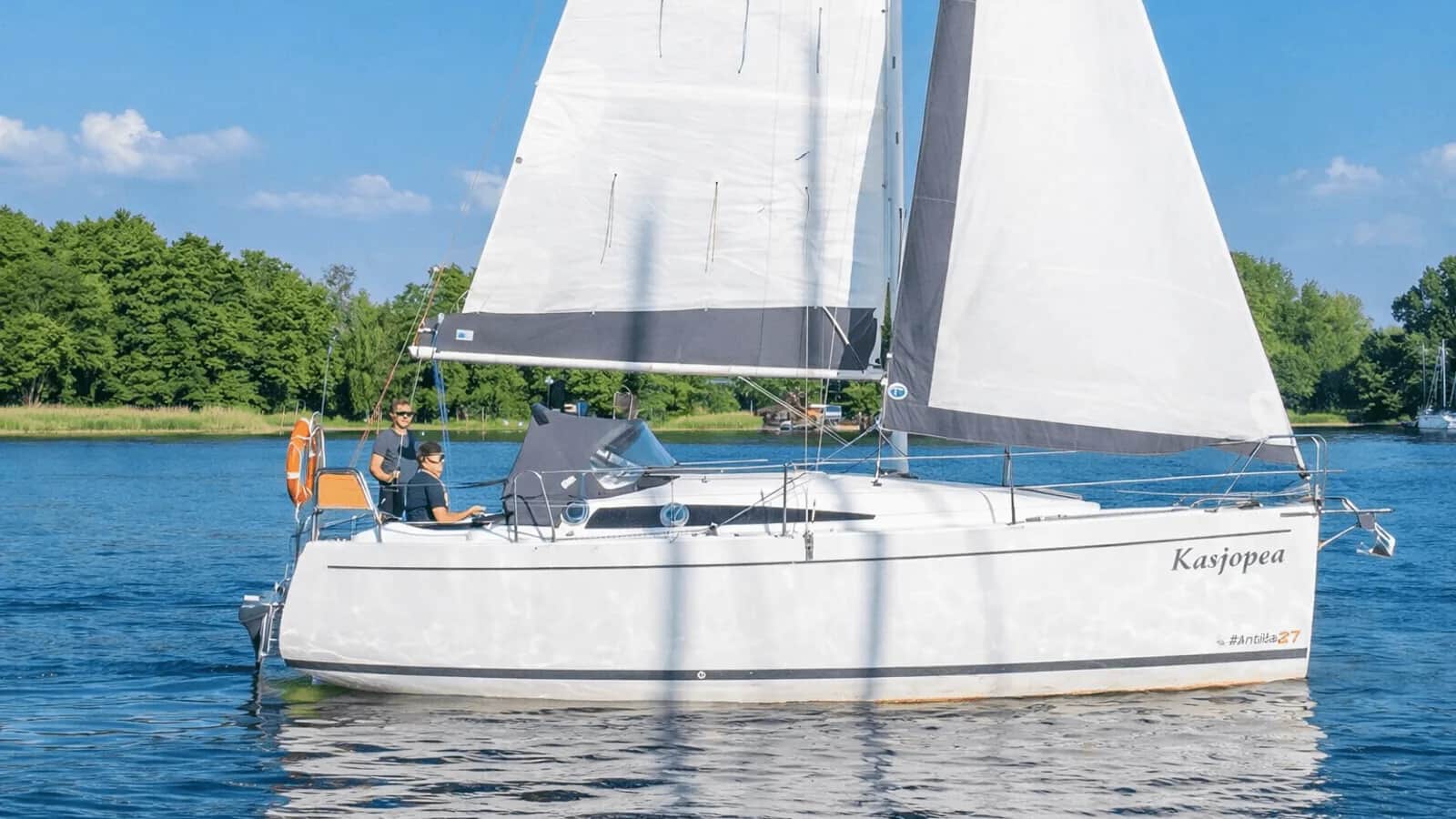
A typical charter yacht in Masuria is a sloop: one mast, a mainsail and one headsail. Behind the mast stands the mainsail, in front of it the jib or the larger genoa. Gennaker and spinnaker serve downwind courses, but a charter boat usually has neither. Afloat, reefing the main and furling the jib matter more than vocabulary.
Almost every Masurian charter sailboat has this layout, from small licence-free boats to yachts for ten.
The mainsail and its parts
The mainsail is set behind the mast, between mast and boom. Its front edge, the luff, runs in the mast groove or rides on slides. The bottom edge, along the boom, is the foot. The back edge is the leech, also called the free edge: it has no support and works hardest. Against flutter it has pockets for battens, flat springy laminate strips that hold the profile.
The corners: the head goes up on the halyard, the tack sits at the mast by the heel of the boom, the clew at the outer end of the boom. Boom, mast and cockpit are covered in the article on the names of yacht parts.
Reefing means reducing sail area. On the main: lower the sail to the next reef, hook the new tack onto the horn at the mast, then take in the reefing line, which pulls the new clew down to the boom. Tie the spare cloth with reef points or leave it in the lazy jacks. On charter yachts you reef at the mast or from the cockpit, if the lines are led there. When and how to reef, step by step: see the guide on reefing sails.
Lazy jacks are a web of thin lines from mast to boom. When you drop the main, it settles on the boom instead of falling into the cockpit and overboard. A big help for a crew of two. The trap: hoist with the bow dead into the wind, or the battens catch the lines. Many sailboats on NaCzarter have lazy jacks and a furling jib; check the yacht's equipment list.
Jib and genoa: the difference
Jib and genoa are headsails, set on the forestay, the steel wire from the upper mast to the bow. The jib fits in the triangle between forestay, mast and deck; its leech does not reach the mast. The genoa is bigger and reaches past the mast: sailors call this overlap. Its sheets run outside the shrouds. In light wind the genoa gives noticeably more drive. In strong wind it gets heavy to handle and slows the tack: a lot of cloth must pass the mast to the other side, and the cloth likes to catch on the spreader tips while the clew and sheets snag on the shrouds. What holds up the forestay and the mast is in the article on the forestay, shrouds and backstay.
On most charter yachts the headsail is on a furler. A furling jib is a jib or genoa wound onto a foil turning around the forestay. You unroll it with the sheet and roll it up with the furling line from the cockpit, without going forward. Partly furled it works like a reef, though the shape goes baggy and the boat points worse. Furl it fully before entering harbour, before manoeuvring under engine and for the night. As the wind builds, reduce both sails a little at a time to keep the boat balanced.
Spinnaker and gennaker: downwind sails
On a run and a deep broad reach the jib hides behind the main and stops working. The spinnaker is a big, symmetrical, balloon-shaped nylon sail on its own halyard. The pole pushes one corner out to windward, held up by the topping lift and down by the downhaul. Guy and sheet control the rest. It takes several practised hands and good communication. The gennaker is its asymmetric, simpler cousin: tack at the bow or on a short bowsprit, no pole, and it works like a very large, full genoa. Easier to set and drop, usually through a snuffer.
A charter boat normally has neither. The owner risks an expensive sail and rig, a first-time crew risks fingers and a bump from the pole. A spinnaker in the water becomes a sack that brakes the yacht and is hard to recover. In Masuria the wind shifts between islands and the route keeps turning. So most crews run on main and jib, sometimes goosewinged, jib on the opposite side to the main. Which courses are off the wind and which close-hauled: see the guide on points of sail.
Storm sails: storm jib and trysail
The storm jib is a small headsail of thick, heavily reinforced Dacron, often orange to show up in a seaway. On a yacht with a furling jib it usually goes on an inner stay. The trysail replaces the main: small area, no boom, sheets led straight to the deck. These are offshore sails, rare in Masuria and practically never on a charter yacht. Reefs in the main and a jib furled to handkerchief size do their job. If it blows hard enough to make you think of storm sails, stay in port. In strong wind Śniardwy and Mamry build a short, steep chop; cross them in the morning or not at all.
What sails are made of and the types of rig
Charter sails are Dacron, a polyester fabric: cheap, durable, and it puts up with careless folding by crew after crew. Over time it stretches and loses shape, so old Dacron points worse. Laminates, bonded layers of film and aramid or carbon fibres, hold shape far better and weigh less, but dislike folding, flogging and sun. Racing sails, not charter sails. If your yacht's sails are blown out, do not fight them for the last degree of pointing. Set them decently using the basics of sail trim and sail on.
The layout of masts and sails is the rig. The sloop, one mast, a main and one headsail, is the standard in Masuria and among cruising yachts worldwide. With a triangular main it is a Bermuda sloop. A cutter has one mast but two headsails, a staysail and a jib ahead of it. A ketch has two masts, the shorter mizzen nearer the stern; it splits the area into smaller sails but adds lines to handle.
Which sail for what: table
The "on charter" column describes a typical yacht in the Masurian offer; individual boats may differ. Compare sailboats with such descriptions, from furling jib to engine, on the page with sailing yachts in Masuria.
| Sail | Where it is set | Points of sail | On charter |
|---|---|---|---|
| Mainsail | Behind the mast, on the boom | All, close-hauled to run | Always, with reefs, often with lazy jacks |
| Jib | On the forestay, ahead of the mast | All; on a run only goosewinged | Standard, usually on a furler |
| Genoa | On the forestay, overlapping the mast | Like the jib, best in light wind | Often instead of a jib, on a furler |
| Gennaker | Tack at the bow or on a bowsprit, no pole | Beam reach and broad reach | Rarely, only if the owner lists it |
| Spinnaker | On its own halyard, windward corner on the pole | Broad reach and run | Practically never |
| Storm jib | Instead of the jib, on the forestay or inner stay | Storm winds, mainly upwind | No, furled jib and reef replace it |
| Trysail | Instead of the main, no boom | Storm winds, any course | No |
Frequently asked questions
How many sails does a charter yacht have? Two: the mainsail and a headsail, jib or genoa. Spinnaker and gennaker are rare extras.
What is the difference between a jib and a genoa? Size. The jib ends before the mast, the genoa overlaps it and gives more drive in light wind. In strong wind it is heavier to handle and slower through a tack.
What is a furling jib? A headsail wound onto a rotating foil on the forestay, unrolled and rolled from the cockpit with the furling line. It can be partly furled instead of reefed.
Do you need to know how to set a spinnaker on a charter? No. Most charter yachts have none; downwind you sail on main and jib. If the owner provides a gennaker, ask at handover to be shown how to set and drop it.
When should you reef the main? Early. If the boat heels hard, rounds up and the helm pulls, the reef is already late. With a strong forecast, reef in port before leaving. Shaking out a reef afloat is easy, putting one in during a squall is hard.
Cover photo: NaCzarter.pl