
NaCzarter Team
Which sails will you see on a yacht?
The mainsail is carried on the main mast, while the jib and genoa are headsails. A genoa extends behind the mast, overlapping the mainsail's area when viewed from the side. A mizzen is carried on the smaller aft mast of a ketch or yawl. A spinnaker is an additional, full, rounded sail for suitable downwind points of sail.
You do not need a catalogue of every sail design for your first trip. Recognising a few names the skipper uses is much more useful. “Get the jib sheet ready” only becomes a clear instruction when you know which sail and line it means. Start with the sail's position on the boat, then look at its shape.
Five names worth distinguishing
| Sail | Where to look | The simplest clue |
|---|---|---|
| Mainsail | At the main mast, behind it on a typical sloop | The sail associated with the main mast and usually a boom |
| Jib | In front of the mast | A headsail, usually smaller than a genoa that overlaps the mast |
| Genoa | In front of the mast, with part extending behind it | A large overlapping headsail |
| Mizzen | On the smaller aft mast of a ketch or yawl | A separate sail on the aft mast |
| Spinnaker | Ahead of the yacht, forming a full shape when set | An additional downwind sail, often colourful |
This table helps you find your way around the deck, but does not replace the inventory. One yacht may have a basic suit of sails, another additional sails as well. The yacht's model name does not determine which sails you receive for a particular charter.
Mainsail: look for the mast, not the largest piece of cloth
On a single-masted yacht with a mainsail and headsail, the mainsail is easy to find: its forward edge is connected to the mast and the sail extends behind it. Do not define it as “always the largest”, though. The apparent size of a sail is not a reliable way to identify it.
Mainsails come in different cuts and handling systems. North Sails describes battened mainsails and versions for in-mast or in-boom furling, among others. Their upper sections also vary in shape. A sail that does not look like the perfect textbook triangle can therefore still be a mainsail.
During handover, ask how this particular mainsail is hoisted and stowed. Do not carry habits from a previous yacht over to equipment you have not yet learned to use. Even as a guest, it is useful to know where the sail is kept and which parts the skipper will handle before departure.
Jib and genoa: both are forward sails
Both are headsails. In the basic distinction, a jib does not have a large overlap behind the mast, while a genoa extends aft of it, partly overlapping the mainsail when seen from the side. This does not mean the fabrics should touch. It describes their geometry viewed from a particular direction. The distinction between overlapping and non-overlapping headsails is also explained in the North Sails guide.
Specifications sometimes give genoa sizes as percentages. UK Sailmakers explains that these compare the LP measurement with the J dimension, rather than stating a percentage of mainsail area. You do not need to understand the measurement calculation to join a trip. Just remember that a “135% genoa” does not mean a sail with an area equal to 135% of the mainsail.
In conversation, a crew may use “jib” fairly loosely. At handover, agree the terminology with the skipper so everyone understands commands in the same way. If the inventory lists a genoa and the skipper says “headsail”, they are not necessarily referring to a different item.
A sail rolled around a furler is harder to identify at a glance. Ask for a demonstration in conditions chosen by staff; do not unfurl it yourself just to check its shape. Learn its associated halyards and sheets at the same time, because a sail's name and its line's name are different pieces of information.
Mizzen: the sail on the second, aft mast
A ketch or yawl has a smaller mizzen mast behind the main mast, and its sail is the mizzen. World Sailing's Equipment Rules of Sailing definitions distinguish the main mast, mizzen mast and their respective sails. Do not look for a mizzen on a single-masted yacht simply because you see two sails.
Imagine two photographs. One boat has a single mast, a sail behind it and another ahead: that is not a mainsail and mizzen. The second has two masts, with the smaller one aft. Only then might “mizzen” help identify the sail on the aft mast. This is a useful observation exercise before stepping aboard.
When choosing a boat, look at its actual sail plan instead of treating the number of sails as a difficulty rating. The tasks the skipper intends to assign and how the available equipment works matter more to the crew.
Spinnaker and gennaker: additional sails have their own jobs
A spinnaker brings to mind a large, colourful balloon in front of a boat. That is a useful visual clue, not a definition: colour alone does not determine the type of sail. Spinnakers can be symmetrical or asymmetrical. North Sails compares both designs and explains differences in shape, equipment and use.
A symmetrical spinnaker has two similar halves and usually works with a spinnaker pole. An asymmetrical sail has distinctly different forward and aft edges. You will encounter “gennaker” for asymmetrical cruising sails used downwind. The precise range of sailing angles and wind strengths depends on the individual design; the name in an offer does not establish those limits.
Before booking, ask whether the additional sail is actually included, requires a separate arrangement and can be handled by your crew. On your first trip as a guest, you do not need to set it by yourself. Ask the skipper to explain your role before the sail comes out of its bag.
A sail's name is not an instruction for using it
Identifying sails, setting them correctly and reducing their area are separate skills. This article helps answer “What am I looking at?” For adjusting their setting, read our sail-trimming guide. Decisions aboard belong to the skipper and must account for weather, equipment and the crew's abilities.
At the start, ask to be shown the sails and lines you will handle. Repeat the names in your own words. If an instruction is unclear, ask before moving a line. Do not identify a function solely by colour: a different yacht may use the same colours differently.
Frequently asked questions
Is the mainsail always the largest sail? No. Its name identifies its place in the sail plan. A large genoa or an additional sail when set may visually dominate the mainsail.
Are a jib and a genoa exactly the same? Both are headsails, but in the basic distinction a genoa overlaps the mast. Check the inventory for the particular boat and agree terminology with the skipper.
Does every sailing yacht have a mizzen? No. It requires an appropriate mast arrangement, such as a ketch or yawl. Two sails on one mast do not mean a mizzen is present.
Do you need a spinnaker for your first trip? It is not an essential part of a recreational sailing plan. Choose sails with the skipper to suit the boat, conditions and crew's skills.
Check which sails you will have aboard
When browsing sailing yachts for charter, check the sail description for the particular boat. Ask for confirmation of additional sails and their equipment if you intend to use them. Knowing their names helps you ask those questions before reaching the harbour.
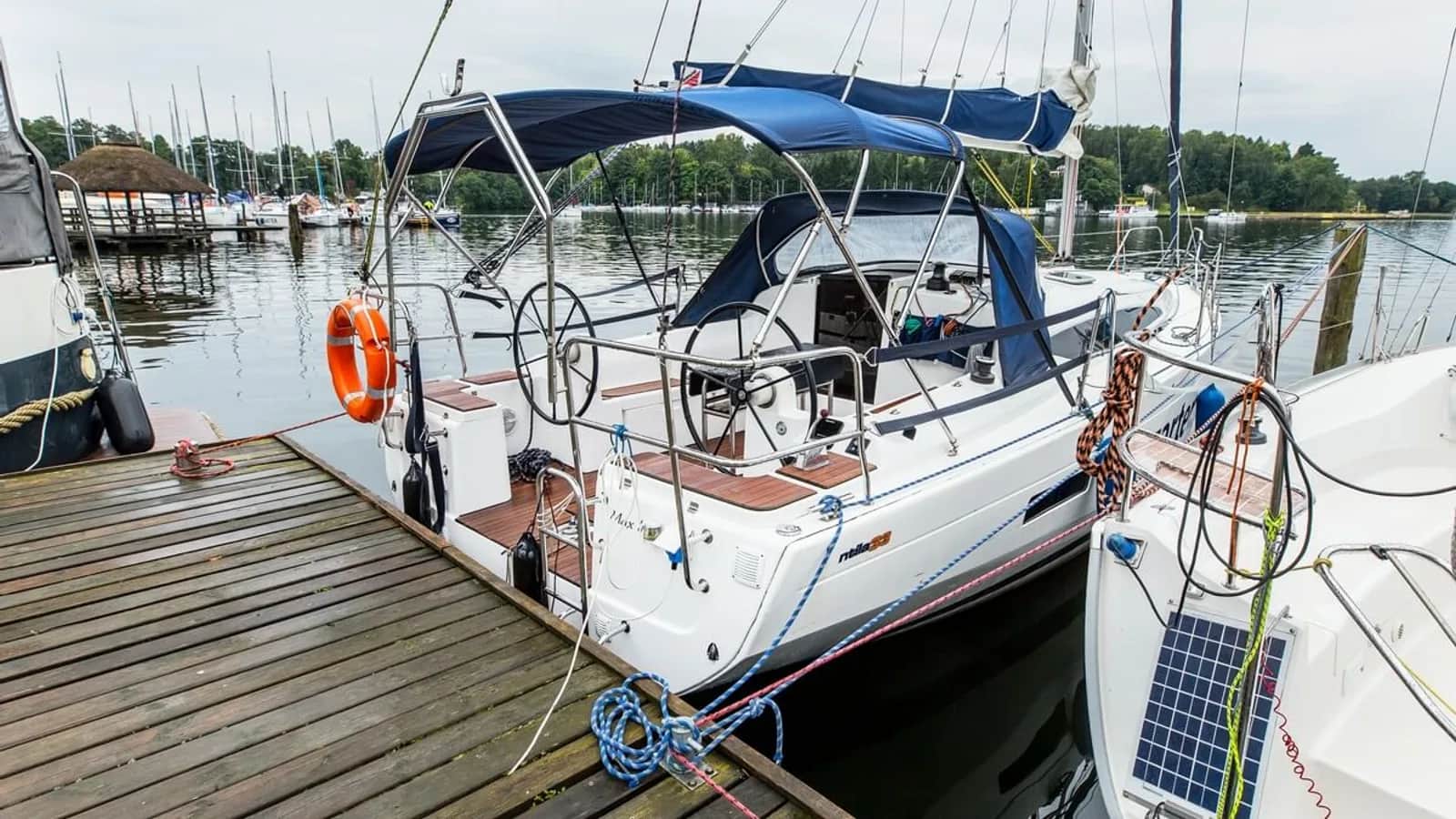
Illustrative photo from the NaCzarter.pl catalog.


