NaCzarter Team
· Updated
A nautical mile is exactly 1,852 metres, and a knot is the speed of one nautical mile per hour — precisely 1.852 km/h. These are two numbers worth keeping in your head whenever you plan a cruise or read a wind forecast. In this guide we explain how long a nautical mile really is, where that odd-looking value comes from, how a knot differs from a kilometre per hour, and how to convert speed on the water in seconds. No physics-class formulas — just plain language.
Nautical mile — how many kilometres
One international nautical mile is 1,852 metres, or 1.852 kilometres. It is a fixed, agreed value used all over the world, so you never have to look it up — just remember it. For comparison, an ordinary land (statute) mile is about 1,609 metres, noticeably less. That is why, when talking about distances on the water, it always pays to know which mile you mean: at sea and in navigation it is always the nautical mile.
In practice, remembering this single number — 1,852 metres — handles most conversions. Ten nautical miles is 18.52 km, a hundred nautical miles is 185.2 km. Simple, no calculator needed.
Where the 1,852 metres comes from
The nautical mile was not invented at a desk. Historically it corresponds to one arcminute of latitude — that is 1/60 of a degree — measured along a meridian. In other words: sail one nautical mile due north or south and your latitude changes by exactly one minute of arc. That is wonderfully convenient for navigation — a full meridian spans 180 degrees, or 10,800 minutes, and the Earth's circumference measured through the poles is about 21,600 nautical miles.
Because the Earth is not a perfect sphere but an ellipsoid slightly flattened at the poles, the real length of one minute of latitude varies from about 1,843 metres at the equator to about 1,862 metres at the poles. To end the disputes, in 1929 the First International Extraordinary Hydrographic Conference in Monaco adopted one round value: exactly 1,852 metres. And so it has stayed.
The knot — a speed, not a distance
This is where the most common mistake hides. A knot is a unit of speed, not of distance. One knot means covering one nautical mile in one hour. Since a nautical mile is 1.852 km, then:
- 1 knot = 1 nautical mile per hour = 1.852 km/h
- roughly, 1 knot is also about 0.514 m/s and about 1.151 mph
You never say 'knots per hour' — that is an error, because the hour is already built into the definition of a knot. Where does the odd name come from? From the old way of measuring speed: a line with knots tied at equal intervals and a wooden panel (the log) was thrown off the stern, and a sailor counted how many knots ran through his hands in a set time measured by a sand-glass. More knots meant a faster boat. Hence 'speed in knots'.
Knots-to-km/h conversion table
The simplest trick: to turn knots into km/h, multiply by 1.852. For a rough mental estimate, add about 85 percent of the figure to itself (almost double it). Here are ready examples:
- 1 knot ≈ 1.85 km/h
- 5 knots ≈ 9.3 km/h
- 10 knots ≈ 18.5 km/h
- 15 knots ≈ 27.8 km/h
- 20 knots ≈ 37.0 km/h
- 30 knots ≈ 55.6 km/h
- 40 knots ≈ 74.1 km/h
It works the other way too: to turn km/h into knots, divide by 1.852 (or roughly multiply by 0.54). So 18.5 km/h is about 10 knots.
Why a sailor needs all this
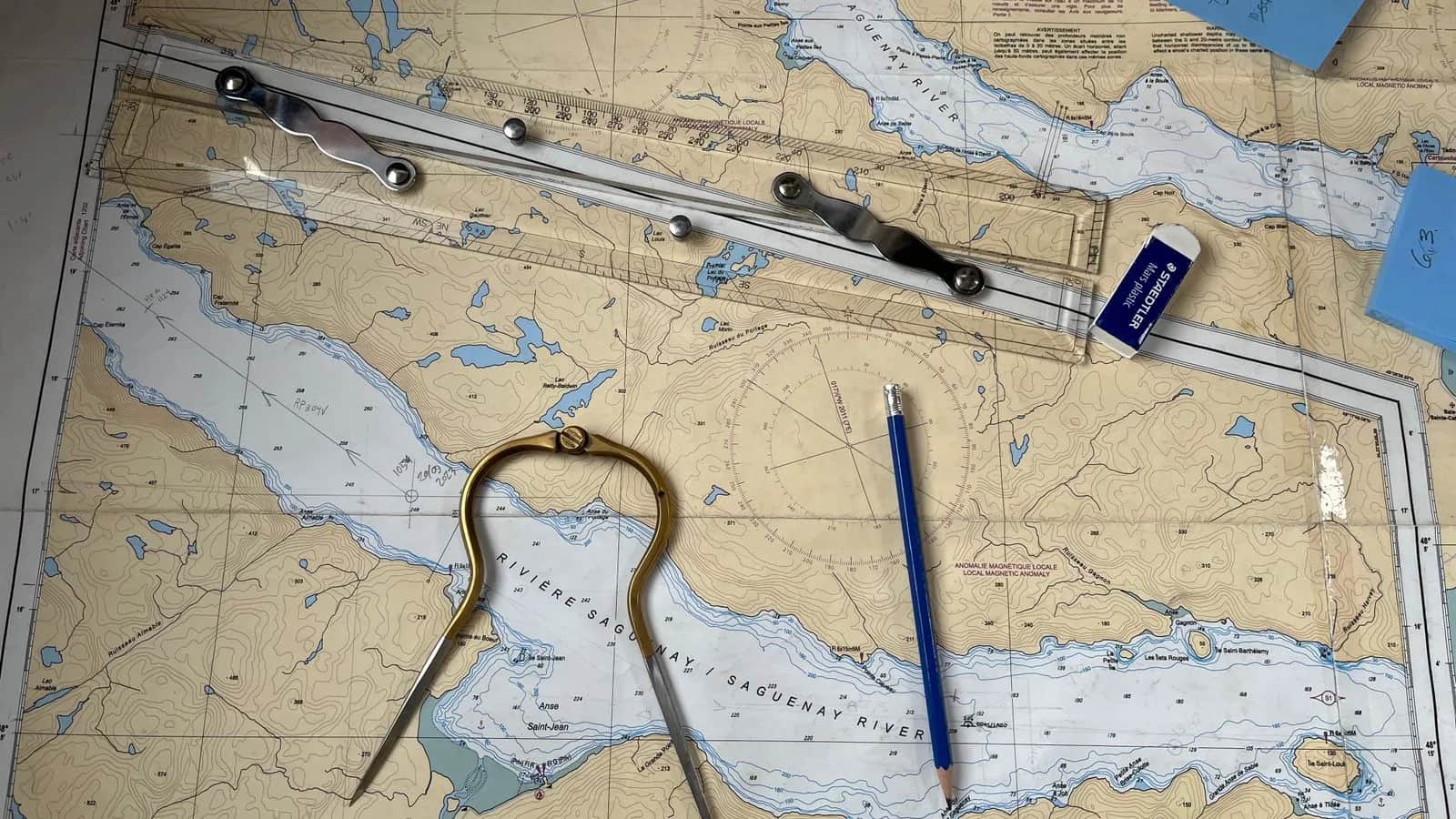
If kilometres exist, why do mariners stick to nautical miles and knots? Because these units fit navigation on a sea chart perfectly. One minute of latitude on the chart equals one nautical mile — just measure the distance with dividers, read it off the side scale, and you instantly know how many miles you have to sail. That is why knots and nautical miles are the standard in maritime navigation, aviation, and weather forecasts worldwide.
And how does it look in Masuria? It is an interesting mix. Distances between ports and lakes here are more often given in kilometres, because it is an inland water and that is simply easier for planning a route. But boat speed, and especially wind strength, is still usually given in knots — both in forecasts and on board. So it pays to feel both scales: to know that 15 knots of wind already means a solid, lively sailing day (about 28 km/h), while 6 knots of boat speed is a pleasant, calm glide across the water.
The best way to make these numbers click is to feel them under sail. If you want to learn to read wind and speed from scratch, check our sailing licence course in Masuria, and if you would rather sail first with someone experienced, see our sailing trips with a skipper. Ready to try it yourself? Take a look at yacht rental in Masuria and set sail with NaCzarter.