NaCzarter Team
· Updated
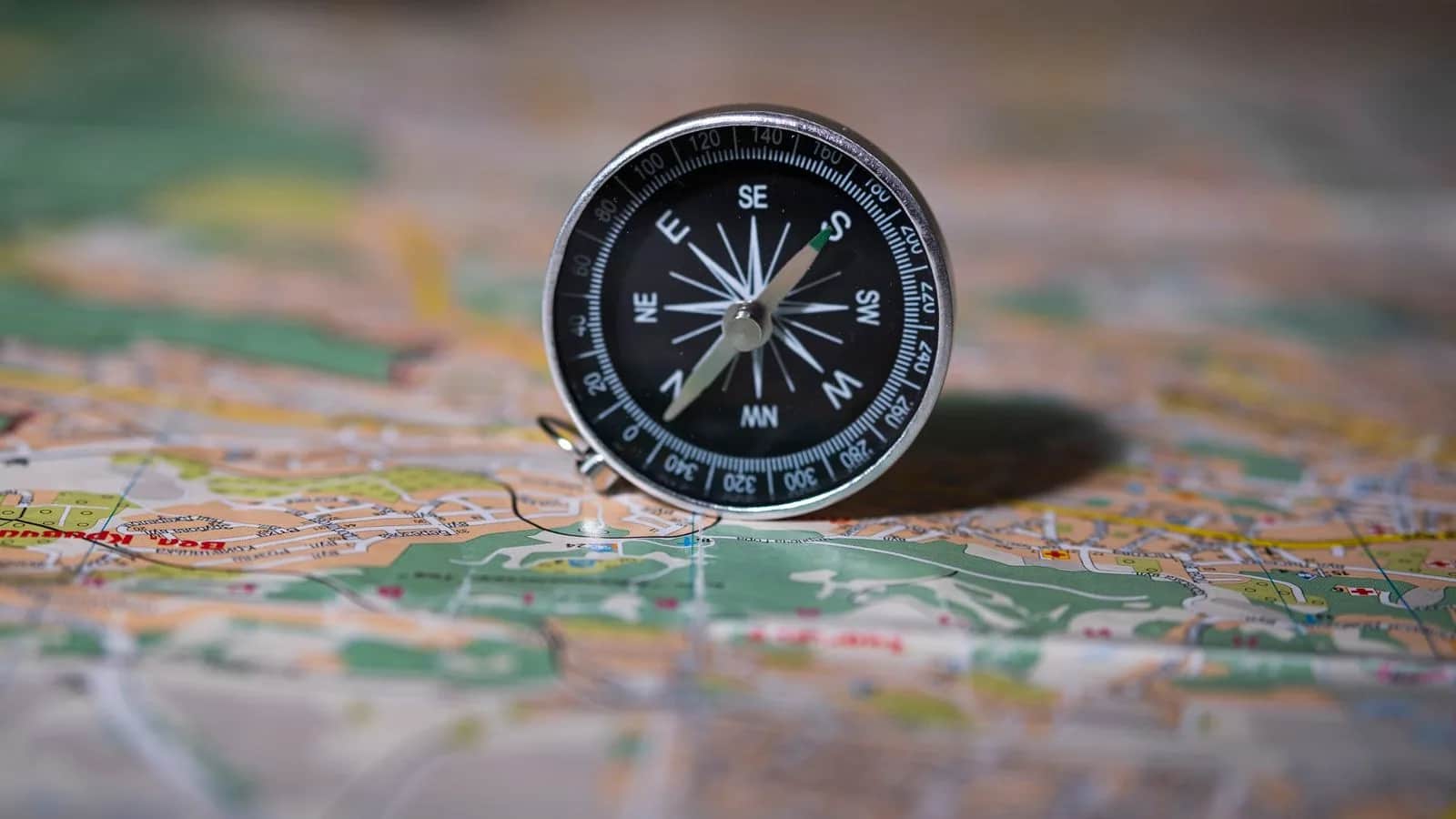
A compass rose is a graduated dial of cardinal directions that brings order to navigation and lets you describe precisely where the wind comes from and where you are heading. On the Masurian lakes, often narrow and ringed by forest, reading a direction quickly matters more than you might think — because it is the wind, not the map, that decides how you trim the sails and where you steer.
What a wind rose is
At its simplest, it is a circular dial marked with a scale and the names of the cardinal directions. You will find it on a compass, on a nautical chart, in the corner of a weather forecast, and tattooed on more than one sailor's forearm. Its job is single: to turn a vague 'it's blowing from over there' into precise information you can hand to a crewmate, log in the journal, or feed into a chartplotter. Without a shared frame of reference, every conversation about course and wind would be guesswork.
Directions and points
The foundation is the four main directions (points), labelled with the English-derived letters now used worldwide:
- N — north
- E — east
- S — south
- W — west
Between them lie the four intercardinal directions:
- NE — northeast
- SE — southeast
- SW — southwest
- NW — northwest
That gives eight directions, which cover most situations in practical sailing. Halving them again yields 16 points (adding NNE, ENE, ESE and so on), and one more division gives 32 points — the full, classic compass rose. The finer the scale, the more exactly you can pin a direction, though on inland water you rarely need more than eight.
Degrees
The second, more precise scale is degrees — the full circle split into 360°, counted clockwise from north. Four reference points are worth memorising:
- N — 0° (and also 360°)
- E — 90°
- S — 180°
- W — 270°
One point equals 11.25° (360° divided by 32). Degrees are the language of modern navigation — courses, bearings and readings from a compass or plotter are all given in them, because they leave no room for ambiguity.
Compass rose vs. meteorological wind rose
Though the names overlap, they do two different jobs. A compass rose is a direction tool — the dial on a compass or chart that says 'north is that way, east is over there.' It is for orientation and setting a course. A meteorological wind rose is a statistical chart: for a given place it shows from which directions, and how often, the wind blows, with the length of each arm reflecting that direction's share, sometimes broken down by strength. The first answers 'where is north right now,' the second 'which winds usually prevail here.' Planning a cruise on the Masurian lakes, you glance at both: the meteorological rose hints at the typical seasonal directions, the compass rose keeps you on course on the water.
Why a sailor needs it
The wind rose links navigation to sail trim. The wind's direction relative to your course gives your point of sail — whether you are close-hauled, on a reach, on a broad reach or running before the wind — and that determines how the sails are set and whether you can reach your destination at all. On a narrow, wooded lake, where the wind bounces off the shore and can shift by several points, naming the direction clearly underpins safe decisions: when to tack, where to find sheltered water, whether you will beat the front rolling in. This skill develops fastest under an instructor's eye — we drill it thoroughly on our sailing licence course in Masuria.
A wind is named after the direction it blows from
This rule trips up beginners, so learn it once and for all: a wind is described by the direction it comes from, not the way it is heading. A north wind (N) blows from the north — that is, it pushes you toward the south. A west wind blows from the west. Currents and waves work the other way (we say where they flow to), but for wind the origin is what counts. Once that logic clicks, forecasts and on-deck commands suddenly make sense.
The best way to feel all this is on the water. If you would rather learn directions by watching an experienced skipper, a good start is sailing with a skipper in Masuria, and when you are ready to set out on your own, browse the available boats at our yacht rental in Masuria.