NaCzarter Team
· Updated
Heavy machinery on Lake Nidzkie
First the construction machinery drove in. Then the soil arrived. The reed bed, which had grown there on its own, disappeared under the dumped earth. The ground by the lake was levelled and the waterside vegetation was cut down.
The plot is in Karwica, in the Ruciane-Nida municipality, on Lake Nidzkie. The 63-year-old owner of the plot, a resident of Kolno, stood trial for destroying the shore. The violation was detected by staff of the Water Supervision office in Mikołajki. The act was classified under Art. 475 of the Water Law Act of 20 July 2017 (consolidated text: Journal of Laws, Dz.U. 2025, item 960, as amended). The owner pleaded guilty and voluntarily submitted to a penalty. The court imposed a fine of 20,000 PLN and 1000 PLN in costs, paid earlier as a financial security. A year passed between the detection of the violation and the judgment.
We checked five reports: the Police portal, Radio Olsztyn, Gazeta Olsztyńska on wm.pl, mazury24.eu and wm112.pl. None of them gives the date of the judgment or the date when the soil was dumped. None of them says whether, along with the fine, an obligation to restore the shore to its previous state was imposed.
So who actually owns the shore
It is a scene every charterer in Masuria knows. A yacht approaches the shore, someone on deck reads the sign "private property, no mooring", and a man comes out from the land and tells them to push off. The crew is sure the water is public. The owner is sure he bought land with the right to decide who sets foot on it. Both sides are wrong about the boundary.
So the question is not "may I moor here". It is: where does the right to the water end and someone else's land begin. The Karwica case is about the same boundary, only seen from the land towards the lake.
Water and lakebed: you cannot buy them
Flowing inland waters are owned by the State Treasury (Art. 211(2) of the Water Law), waters of the State Treasury and of local government are public waters (para. 3), and para. 4 settles the matter: they cannot be traded under civil law, except where the Act provides otherwise. The same applies to the bed (Arts. 216 and 217). Ownership rights are exercised by PGW Wody Polskie, the Polish Waters authority (Art. 212(1)(1)).
Why "flowing waters" for a lake? Because of Art. 22(2): a through-flow lake has a natural inflow or outflow of surface water, continuous or periodic. The Masurian lakes linked by the waterway are like that, and the Great Masurian Lakes System is listed among the inland waterways (Regulation of the Council of Ministers of 26 June 2019, Journal of Laws item 1208).
The shoreline: a boundary set by decision
Art. 220(1) gives three criteria: the edge of the bank, or the line of permanent grass growth, or the line based on the average water level from at least ten years, and paras. 2 to 4 rank them, giving priority to a clear bank edge. The key provision is para. 5(2): the shoreline is set by an administrative decision, and for lakes the authority is the minister responsible for water management, based on a demarcation design prepared by a surveyor (paras. 6 and 7).
This applies directly to Karwica: the shoreline is a legal category, not wherever the water reaches in a dry August. Dumped soil does not move it. There is a gap here, though: the decision is issued when someone applies for it or when the authority opens proceedings, and we have not established for how many Masurian waterfront plots one has been issued. Until there is one, a dispute about where to measure the metre and a half from is a dispute about facts.
The strip by the water: passage, not a stop
Art. 232(1) contains two separate prohibitions: on fencing properties adjacent to public inland surface waters closer than 1.5 metres from the shoreline, and on prohibiting or preventing passage through that area.
This has to be said from both sides. The strip lies on private land. The owner mows it, maintains it and pays tax on it, and the Act takes away his right to fence it off. It is a public burden placed on private land. On the other hand, the provision speaks of passing, and only of passing, not of camping or of a yacht stopping there. Nor does it guarantee that you can actually get through: the strip is sometimes waist-high reeds or a steep bank, and nobody is obliged to lay a path there.
The exceptions are narrow: areas of direct protection within protection zones and fish-breeding areas under the Inland Fisheries Act (para. 2), closed areas (para. 3) and an exemption by decision of Polish Waters for national defence or public security (para. 4). Mind the word "direct", because indirect protection is not excluded.
Breaking the prohibition is punishable by a fine of 1000 to 7500 PLN; the range was written directly into Art. 478(2) by the amendment of 13 July 2023 on the revitalisation of the Oder River, and the court rules under the Code of Procedure for Petty Offences (Art. 479). Reports go to the water supervision office; who then files the request for punishment, we have not established. Signs and barriers are not named in the Act; they fall under "preventing passage" only by way of interpretation.
Art. 233(2) works separately: the owner of a property adjacent to waters open to general use must provide access to the water, and the parts of the property that provide this access are designated by decision of the wójt (head of a rural municipality), the mayor or the city president. This is an instrument about access to water, not about mooring.
Mooring: the gap nobody talks about
Art. 32(1) gives everyone the right to general use of public inland surface waters, unless the regulations provide otherwise. Para. 2 lists what it serves: personal, household or farm needs without special technical equipment, as well as recreation, tourism, water sports and amateur fishing.
This list is worth reading twice. Mooring is not on it, and neither is stepping onto someone else's shore land. General use lets you be on the water: sail, swim, relax. It gives you no title to tie a yacht to someone else's tree, because there it is someone else's property that decides.
And the strip of reeds into which half of Masuria pushes its bows? If the reeds grow on land covered by water, that is State Treasury land (Arts. 216 and 217). Where that boundary runs is settled only by a shoreline decision, which is usually missing; at low water and under the permanent-grass-growth criterion, the reed strip need not lie on the water side. By a plot with buildings and a mown lawn, it is more sensible to assume that the boundary runs in the owner's favour. The most important point is something else, though: whoever owns the ground, ownership of the bed gives no right to destroy the vegetation.
What this means at the shore
- A yacht at anchor, on the water, with nobody going ashore: that is general use of public waters, and nobody has a title to send you away from there.
- Bow in the reeds: no. Whoever owns the bed, it is a reed bed and shallow water, and on top of that there is the keel, the rudder and the engine cooling. Charter contracts usually forbid it.
- A line from the bow to someone else's tree is use of someone else's land, so without the owner's consent we take it off. A yacht with its bow on someone else's land or at someone else's jetty: we push off without discussion.
- A stake driven into a sandy bank and pulled out in the morning is not reshaping the shore. The problem is permanent interference: fixed posts, a dug-up bank, a cut passage.
- Harbour full at six in the evening: if it is light and there is somewhere to go, we go on; if dusk is falling, we drop anchor well away from the shore and move on in the morning. The same in a squall or a breakdown: we shelter under the least built-up shore, leave once the front has passed, and tell the owner why we are there.
The second layer: navigation rules
The Water Law is not everything. A second layer of rules applies to the same shore, one that hardly ever comes up in mooring disputes, yet it deals with mooring directly. These are the navigation rules: the Regulation of the Minister of Infrastructure of 28 April 2003 on navigation rules on inland waterways (Journal of Laws No. 212, item 2072) and a local act, Order No. 7/2024 of the Director of the Inland Navigation Office in Bydgoszcz of 4 June 2024. Bydgoszcz sounds far from Giżycko, but it is this office, through its branch in Giżycko, that issues the local regulations for the Great Masurian Lakes.
The most important provision for a crew is § 9(1)(1) of the Order. It prohibits navigating a power-driven vessel less than 50 metres from the shore outside the fairway, including from the line of permanent grass and other vegetation above the water, and from jetties, equipment rentals, bathing areas and people in the water. The prohibition sounds strict, and most people stop reading at this point. Yet further on there is a sentence more important than the prohibition itself: "except for passage at minimum steerage speed and by the shortest route to the place where the manoeuvre of approaching the shore, quay or jetty is performed".
So the law does provide for approaching the shore. Not as a right to someone else's land, but as a normal manoeuvre that has to be done slowly and in a straight line. Note the scope: the provision speaks of a power-driven vessel. A yacht under sail is not one; the same yacht under engine is.
On top of that come three navigation signs from the 2003 regulation which decide locally about stopping:
- A.5 no stopping,
- A.6 no anchoring and no dragging of anchors,
- A.7 no mooring to the bank.
Since the legislator created a separate sign prohibiting mooring, it means that where there is no such sign, the navigation rules do not prohibit mooring. That is not the same as the landowner's consent, but it puts an end to the myth that mooring outside a harbour is illegal in itself. It is not.
Anchoring in Masuria is governed by a rule that is easy to twist. The prohibition on anchoring and dragging a chain or line applies to canal sections and to harbours and marinas, and lakes are expressly excluded from it. Lying at anchor in the middle of a lake is therefore something different from stopping on a canal, where an anchor is out of the question unless there is a designated turning area. Separately, the regulation prohibits using navigation signs for mooring vessels and damaging hydraulic structures by driving in piles or dropping anchors.
Finally, two things that are not about mooring but settle half of the rows on the shore. On rivers and the canal, unless the signs say otherwise, there is a speed limit of 10 km/h, with vessels propelled by human muscle or by wind exempt from it. And there is a ban on producing a high wash and excessive propeller suction closer than 50 metres from the shore, jetties, quays, rentals and swimmers. Wash is not a question of manners. It is an offence.
Two axes you must not confuse
It is worth separating them once and for all, because in an argument on a jetty both sides usually mix one up with the other.
- The traffic-safety axis: the navigation rules say how you may move and where you may stop. They are set by signs and by the order of the director of the navigation office. They are enforced by the navigation administration and the police.
- The ownership axis: the Water Law and the Civil Code say whose land it is that you step onto or tie a line to. The absence of an A.7 sign gives no title to someone else's plot, and the owner's consent does not cancel a prohibition shown by a sign on the shore.
So you can be right on one axis and wrong on the other. The most common case in Masuria: you moor legally from the point of view of the navigation rules and illegally from the point of view of the landowner. Or the other way round: the owner invites you to his jetty, which stands in a zone marked with a no-stopping sign.
Jetties: two procedures and one dispute
A jetty looks like a minor bit of construction, but legally it is a water facility. Up to 3 metres wide and 25 metres in total length, counted as the sum of the lengths of its elements, a water-law notification is enough (Art. 394(1)(1)). Exceeding either dimension moves the matter to a permit (Art. 389(6) in conjunction with Art. 16(65)), and since the sum of the elements is what counts, one added small gangway can tip the classification.
That leaves the dispute. Polish Waters and part of the administrative court case law (II SA/Wr 76/18, II SA/Wr 159/20) take the view that a structure used for mooring is already a marina, so it requires a permit regardless of its dimensions; Art. 16(65)(c) lists piers, jetties and marinas as water facilities. This is the interpretation of the authority and the courts, not a literal prohibition in the Act, and it remains in tension with the Construction Law, which described jetties as serving, among other things, the mooring of small vessels.
Reeds grow in the water
First, what a reed strip means for a lake. This is knowledge widely accepted in hydrobiology, not our own measurement. The filter is not the plant itself but the system: slowed flow, settling of suspended matter, processes in the root zone. Cutting the reeds does not replace that system; it destroys it. A reed bed dampens waves and holds the shore, and below it lie shallows with submerged vegetation where, from March to July, one species after another spawns: first pike, then rudd, and in high summer tench.
Birds call for precision, because the list is often stretched. Truly tied to reeds over water are the great reed warbler and the bittern, and the bittern needs a large reed bed, so for a single plot we are talking about the great reed warbler rather. Other reed-bed species nest more widely, but as the shore is built up, their alternatives disappear with each further levelled piece.
Now the law. Polish Waters, in its "Stop the devastation of lakes" campaign, says it plainly: without water-law consent the following are prohibited: dredging lakes, destroying waterside vegetation (including cutting reeds and waterside trees), building jetties and reinforcing banks. In Pisz County proceedings were held for a water-law permit to cut reeds on Lake Zdedy, so this is not something an owner does on his own initiative. Species protection comes on top: destroying a reed bed with nests of protected birds may breach the Nature Conservation Act of 16 April 2004 (Art. 52(1)(7), Art. 131(13)). The often repeated period from 1 March to 15 October is a collective framework for many species, not a calendar ban for reeds; what counts is whether protected birds nest at that particular place.
Cutting is not the same as filling in
Mowing above the water surface is reversible: the reeds grow back from the rhizomes the next season. Mowing below the water surface, pulling out the rhizomes and repeating it every year can kill a patch permanently, because flooded, cut stems no longer supply oxygen to the rhizomes. This is how reed beds most often disappear along private shores: not with an excavator, but with a scythe under water, year after year.
Filling in goes further, because it moves the shore into the lake. Right beyond the new edge the water is too deep and the slope too steep for reeds to take root, and the muddy bed with rhizomes is gone. So there is nothing to grow back from. A single fill is local, but a built-up shore is the sum of pieces, and the lake responds to the sum.
Three levels of liability
It is worth separating them, because they get mixed up even in conversations with officials. The administrative level means notifications, permits, legalisation and the obligation to remove a facility. The petty-offence level is Art. 478(2), i.e. fencing, ruled on by a court under the Code of Procedure for Petty Offences. The criminal level is Art. 475.
"Whoever destroys or damages the banks of inland surface waters, the banks of marine waters, structures, including walls, which are not water facilities and which form a bank, or land covered by inland surface waters shall be subject to a fine, restriction of liberty or imprisonment of up to one year."
The provision has not been amended since 2017, and it was on this basis that the owner of the Karwica plot was convicted, because shallows were filled in there, that is, land the provision names expressly. This is not Art. 181 of the Criminal Code, because that article concerns destruction of plant or animal life on a significant scale and does not mention banks.
The element of the offence is destroying or damaging a bank, not every contact of a hull with land. The classification concerns actions that permanently reshape the shore: digging into the bank with machinery, altering the shoreline, filling in shallows. We know of no case law on minor interference and we do not pretend there is any. Cutting reeds on its own has a different legal basis: water-law consent and the Nature Conservation Act.
The third layer: places where you may not go at all
So far we have written about the shore as if the same rules applied everywhere. They do not. In Masuria there are waters where the whole discussion above about someone else's land and the 1.5-metre strip is beside the point, because you may not approach or go ashore there, regardless of who owns the shore.
The basis is the Nature Conservation Act of 16 April 2004. Its Art. 15(1) begins with the sentence "In national parks and nature reserves it is prohibited to", followed by a list of several dozen prohibitions. For a boater three of them matter:
- point 21 prohibits "using motorboats and other motorised equipment, practising water and motor sports, swimming and sailing, except on waters or routes designated by the director of the national park, and in a nature reserve by the regional director for environmental protection".
- point 15 prohibits walking outside designated trails, in a reserve likewise designated by the regional director for environmental protection.
- point 23 prohibits camping outside places designated in the same way.
Note how this provision is built, because it works the opposite way from everything else in this text. Not only motorboating is prohibited, but expressly swimming and sailing too. And it is not the case that something is allowed until someone prohibits it. It is the reverse: by default it is not allowed, and an exception has to be designated by the regional director for environmental protection. This is the strictest layer in this whole piece.
For a deliberate breach of the prohibitions in force in a reserve, Art. 127 of the Act provides for detention or a fine. The ranges, detention from 5 to 30 days and a fine from 20 to 5000 PLN, are the ranges of the Code of Petty Offences, so we are talking about a petty offence, not a crime. The same Art. 127 also covers landscape parks, protected landscape areas and Natura 2000 sites.
Islands you may not set foot on
The most practical example lies a few miles from Giżycko. The "Islands on Lakes Mamry and Kisajno" reserve was established by an order of the Minister of Forestry and the Timber Industry of 23 January 1957 (Monitor Polski 1957 No. 14, item 108). It covers 215.35 hectares and all twenty islands on these lakes, in the municipalities of Węgorzewo and Giżycko, from patches of a few ares to the seventy-hectare Upałty. On Kisajno they include Duży Ostrów, Sosnowy Ostrów, Górny Ostrów, Mały Ostrów, Wielka Kiermuza and Dębowa Górka. The reserve protects the breeding grounds of waterbirds and the resting places of birds on migration, and together with the islands, the reed beds around them.
The Giżycko Forest District puts it briefly: on all islands that are nature reserves there is an absolute ban on entry and camping. Now we know where it comes from, because the foresters' website does not give the legal basis. The camping ban is point 23, and the ban on approaching by boat is point 21. Entry is subtler, because the Act knows no separate ban on entry: point 15 applies, which prohibits walking outside trails designated by the regional director for environmental protection. Where no trail has been designated, every landing breaches that ban.
On Kisajno, then, the answer to the question "can I land on an island" is: no, on none of them. It is one of those cases where the holiday reflex of stepping off onto a deserted islet and lighting a campfire is an offence in three ways at once.
Lake Nidzkie and the quiet south
A second example, because it concerns the lake we started with. The "Jezioro Nidzkie" (Lake Nidzkie) reserve was established on 27 October 1972 (Monitor Polski 1972 No. 53, item 283), and by an order of the Regional Director for Environmental Protection in Olsztyn of 26 April 2016 (Official Journal of the Warmian-Masurian Voivodeship 2016, item 1887) it was enlarged from 2934.71 to 2950.87 hectares. It lies in the municipalities of Ruciane-Nida and Pisz. It protects the landscape of the lake together with the surrounding forests of the Pisz Forest, and it is supervised by the regional director for environmental protection.
Water tourism is allowed there, but in the southern part of the lake there is a ban on using combustion engines. Anyone sailing from Ruciane onto Lake Nidzkie should know this before they hear it from someone else.
Masurian Landscape Park: prohibitions on the main route
A separate layer, weaker than a reserve but covering a much larger area, including a big stretch of the main Masurian route. The Masurian Landscape Park now operates under Resolution No. XLIV/635/22 of the Regional Assembly of the Warmian-Masurian Voivodeship of 29 November 2022 (Official Journal of the Warmian-Masurian Voivodeship 2022, item 5615). It covers 56,257.83 hectares in the counties of Mrągowo, Pisz and Szczytno. Its boundaries are set by coordinates in an annex, not by municipal boundaries, and that matters more than it seems: Lake Nidzkie is not part of the Park, although the Ruciane-Nida municipality is.
Of § 5(1) of the resolution, four prohibitions matter for our topic:
- point 13: a ban on using motorboats and other motorised equipment on open bodies of water. Para. 2 lists the exceptions, and the list is short: Śniardwy without Lake Kaczerajno and Łuknańska Bay, Bełdany without Iznocka Bay and Wygryńska Bay, Guzianka Wielka together with the part of Guzianka Mała between the lock and Guzianka Wielka, and Lake Mikołajskie. So the main route is open, but turning off into a side lake of the Park is another matter. A houseboat counts as motorised equipment.
- point 7: a ban on building new structures within a hundred-metre strip from the shoreline, except for structures serving water tourism, water management or fisheries. This exception is worth remembering, because there is a belief going around that you cannot put up a jetty in the Park. You can, only the Water Law procedures described above still apply.
- point 8: a ban on eliminating, filling in and transforming bodies of water, oxbow lakes and wetlands.
- points 3 and 5: a ban on destroying waterside trees and on earthworks that permanently distort the landform.
The last three points describe almost exactly what happened in Karwica. Honesty requires us to add, however, that they do not apply on Lake Nidzkie, because the Park does not extend there. If the same excavator had been working on Bełdany or Lake Mikołajskie, Art. 475 of the Water Law would have been joined by a second basis of liability, with a penalty under Art. 127 of the Nature Conservation Act.
Quiet zones: the county decides
A quiet zone does not come from the Water Law. The basis is Art. 116(1) of the Environmental Protection Law of 27 April 2001: a county council may, by resolution, restrict or prohibit the use of vessels on specified bodies of water if this is necessary to ensure appropriate acoustic conditions in recreational areas. The county council, not the municipality and not the manager of a resort on the shore.
The scope varies: a total ban, or restrictions on engine power, time of day, season or part of the water, and typical exemptions cover rescue and uniformed services and maintenance work. Liability for breaches is governed by statutory provisions that we do not discuss here. Resolutions are published in the official journal of the voivodeship and in the Public Information Bulletin (BIP) of the county office; the person in charge of the vessel is responsible, and the current version is the binding one.
It is also one of the few tools available to a shore resident who has an engine running under the window for three months. Only the tool is heavy. The case law of the administrative courts, including a 2022 judgment of the Supreme Administrative Court (NSA), requires the resolution to be preceded by real studies of the acoustic situation, and resolutions based solely on the wishes of residents are sometimes overturned. The studies cost money and are commissioned by the authority, so this is a route for a group of residents or a municipality, not for one person.
What follows, within the scope of the provisions discussed
| Activity | The position | Legal basis |
|---|---|---|
| Sailing, swimming, relaxing | Allowed as general use, unless the regulations provide otherwise. Fishing has separate rules, which we do not discuss | Art. 32(1) and (2) of the Water Law |
| Walking through the strip along the shore (the area 1.5 m from the shoreline) | The owner may not fence it or prevent passage, apart from the exemptions in paras. 2 to 4. It is a ban on fencing, not a guarantee of a path or consent to stop | Art. 232(1) to (4) |
| Landing on someone else's shore, going ashore, tying up to someone else's jetty or tree | General use does not cover it. Only with the owner's consent | Art. 32(2) |
| Access to the water through someone else's property | A separate instrument: the parts of the property providing access to the water are designated by decision of the wójt, the mayor or the city president. It does not create a right to moor | Art. 233(2) |
| Fencing a plot closer than 1.5 m from the shoreline | Petty offence, fine from 1000 to 7500 PLN, ruled on by a court | Art. 232, Art. 478(2), Art. 479 |
| Building a jetty up to 3 m wide and 25 m in total length | Notification to the water supervision office, works may start after 30 days without objection, plus an agreement for the use of land covered by water for an annual fee. Larger dimensions: water-law permit | Art. 394(1)(1), Art. 397(3)(3), Art. 423(2), Art. 261(1)(6) and (4); Art. 389(6) |
| Keeping an unauthorised jetty without papers | Legalisation with a fee (6601.67 PLN in 2026) or a removal decision | Art. 190(1), (2) and (13) |
| Cutting reeds, dredging the bed, reinforcing the bank | Prohibited without water-law consent; where protected birds nest, the Nature Conservation Act also applies | position of Polish Waters; Art. 52(1)(7) and Art. 131(13) of the Nature Conservation Act |
| Destroying or damaging a bank, for example by filling in shallows | A crime: fine, restriction of liberty or up to one year of imprisonment | Art. 475 of the Water Law |
| Running an engine on water with a quiet zone | Depends on the scope of the current county council resolution | Art. 116(1) of the Environmental Protection Law |
The table covers only the provisions discussed in this text. Additional restrictions based on other grounds may apply on a particular body of water.
What sailors actually do
The law is one thing and practice another. In Masuria there is one more layer, never announced anywhere: custom. We looked through public sailing discussions, from archived newsgroups to forums, to see what people agree on among themselves. The caveat is obvious and has to be stated right away: these are not sources of law, only a description of what people do and argue about. We do not quote nicknames or names, because these were private conversations from years ago, not statements to the press.
The strongest custom is the "port of refuge". Sailors consistently describe an unwritten rule: in a storm or after a breakdown you may treat someone else's jetty as a refuge, free of charge, and then find the owner and explain why you are there. The rule sounds so obvious that hardly anyone checks whether there is a legal provision behind it. Sailors themselves call it "customary", which means they assume from the outset that there is no provision.
Well, there is, just not where they look for it. Not in the Water Law and not in the navigation rules, but in the Civil Code. Art. 142 § 1: "The owner may not object to the use, or even the damage or destruction, of a thing by another person if this is necessary to avert a danger directly threatening the personal interests of that person or of a third party. He may, however, demand compensation for the resulting damage". Paragraph 2 extends this to property interests, unless the threatened damage is obviously and disproportionately smaller than the owner's loss.
Let us apply that to a squall on Kisajno. If the health or life of the crew is at risk, the jetty owner may not object to you tying up there. That is not courtesy on his part; it is the law. If only the yacht is at risk and the crew is safe, paragraph two applies, and then you have to weigh things up: someone else's jetty worth thousands against the damage you are trying to avoid.
Two things in the custom that this provision corrects. First: it is about real danger, not about it being windy and too much hassle. Second: "free of charge" is only half true. The owner has nothing to claim for the stay itself, but for a torn-off cleat or scratched boards he does, because the sentence about compensation stands in the same paragraph. So custom and the law say roughly the same thing, with one difference: the law ends with a bill for the damage, and custom ends with a thank-you.
The second thing is a dispute that sailors have been having among themselves for years. Some read into Art. 232 a right to moor within the 1.5-metre strip. Others correct them that the strip is for passing, not for stopping or camping. The second reading matches the letter of the provision. It is worth knowing, though, that the first one circulates in the sailing community, because half of the misunderstandings on the shore come from exactly this: the crew is convinced it has a right it does not have, and the owner hears someone invoking a provision and gets doubly furious.
The practices sailors recommend to one another are more sensible than the disputes:
- Lie at anchor or on a screw-in anchor and do not go onto someone else's land at all. This sidesteps the legal problem instead of settling it, and it works.
- Avoid mooring by private plots if there is an alternative. The alternative is often a passage just ten minutes longer.
- When the owner is there and does not want you, push off without discussion. One unbeatable argument comes up here: why should we glare at each other.
- Ask before you tie up. That is usually enough, and sometimes it ends with a coffee.
These conversations also keep coming back to the claim that things used to be more hospitable, and that new owners from outside the region tend to be especially strict. What is interesting is that the same people immediately admit where the reluctance comes from: litter after the weekend, music late at night, how often boats moor at the same jetty. So both sides are talking about the same thing, only from two sides of the jetty.
From the other side of the jetty
We did not talk to any plot owner or to the parties to the Karwica case. That is a gap, and this reconstruction should be read accordingly: it summarises arguments repeated in public discussions about Masuria, not anyone's statement. They go roughly like this: a plot bought with one's own money, tax every year, the cost of maintaining the shore, other people's litter after the weekend and music from boats at two in the morning. How many crews behave like this, nobody has counted, and neither have we.
The law largely agrees with the owner. General use ends at the shoreline, the 1.5-metre strip is for passing, and litter and night-time parties have no basis in Art. 32. What he can do legally:
- Outside the 1.5-metre strip from the shoreline he can ask people to leave his land, unless a decision under Art. 233(2) designating parts of the land that provide access to the water has been issued for the property.
- He reports damage to the shore, including damage caused by others, to the water supervision office. Where a shore has been destroyed, the case may go to the police.
- He builds a jetty through a notification or a permit plus a land use agreement; an unauthorised one is either legalised or gets a removal decision.
- For engine noise, the route leads to the county council and a resolution under Art. 116(1) of the Environmental Protection Law, realistically as a matter for a group of residents or a municipality.
- For litter and night-time music, the Water Law provides no tool. That route goes beyond the scope of this text.
One thing he may not do, and that is where the Karwica case begins. He may not solve the problem by fencing off the shore strip or reshaping the shore to suit himself. The law protects the land; it does not give power over the shore.
Who actually enforces this
Reports are received by Polish Waters. The Lake Nidzkie case was detected by staff of the Water Supervision office in Mikołajki, the lowest level of that structure. Not a special team, not an inspection from Warsaw. Polish Waters states on gov.pl that its staff take calls from residents every day and check every report on site. Criminal proceedings are conducted by the police, here the County Police Headquarters in Pisz with its station in Ruciane-Nida. How many such cases there are each year is unknown, because there are no statistics.
Questions that remain
The first concerns the shore. The fine has been paid and the case is closed, but none of the five sources says whether an obligation to restore the previous state was imposed. A penalty acts on the offender, restoring the shore acts on the lake, and filled-in shallows will not come back because a fine has been paid: restoring the previous state does not mean replanting vegetation, but removing the soil and recreating the profile of the bed. The case ended with a voluntary submission to a penalty, that is, an agreement on the content of the judgment, and whether anyone demanded restoration of the shore, we have not established.
The second question is a mirror image, and plot owners are owed it. Since there is usually no shoreline decision, how is an owner to know where his land ends before the machinery drives in, and does anyone tell him when he buys the plot or reports the works? Criminal liability for crossing a boundary that nobody has formally set weighs as much as the lack of an obligation to restore the shore. We are putting both questions to the court and to the water supervision office, and we will add the answers.
Frequently asked questions
A neighbour is filling in the shore or has fenced off the passage. Where do I report it? To the locally competent water supervision office of Polish Waters. That is how the Lake Nidzkie case came to light. Where a shore has been destroyed, the case may go to the police as a crime under Art. 475 of the Water Law.
Where can I check whether a lake has a quiet zone? In the current resolution of the council of the county in which the water lies, published in the official journal of the voivodeship and in the BIP of the county office. The scope is sometimes narrowed to the type of propulsion, the time of day or part of the water, so read the whole resolution.
Can I anchor in front of someone else's plot? On public water, yes. Without going ashore, without a line to someone else's tree and without your bow in the reeds.
Disclaimer and editor's note: this is informational material, not legal advice. The legal position is as of August 2026; in a dispute, the circumstances of the case and the resolutions of the competent authorities decide. We cite case numbers after the authority's position and published sources, not from our own search. NaCzarter brokers yacht charters in Masuria, so we have an interest in people staying in harbours. That is why the body of the text is based on legal provisions and public statements, and the links to our guides are gathered below.
Our practical guides (not a source of law):
- wild mooring in Masuria
- a night at anchor
- anchoring a yacht
- Lake Nidzkie
- harbours and marinas
- where to moor in peak season
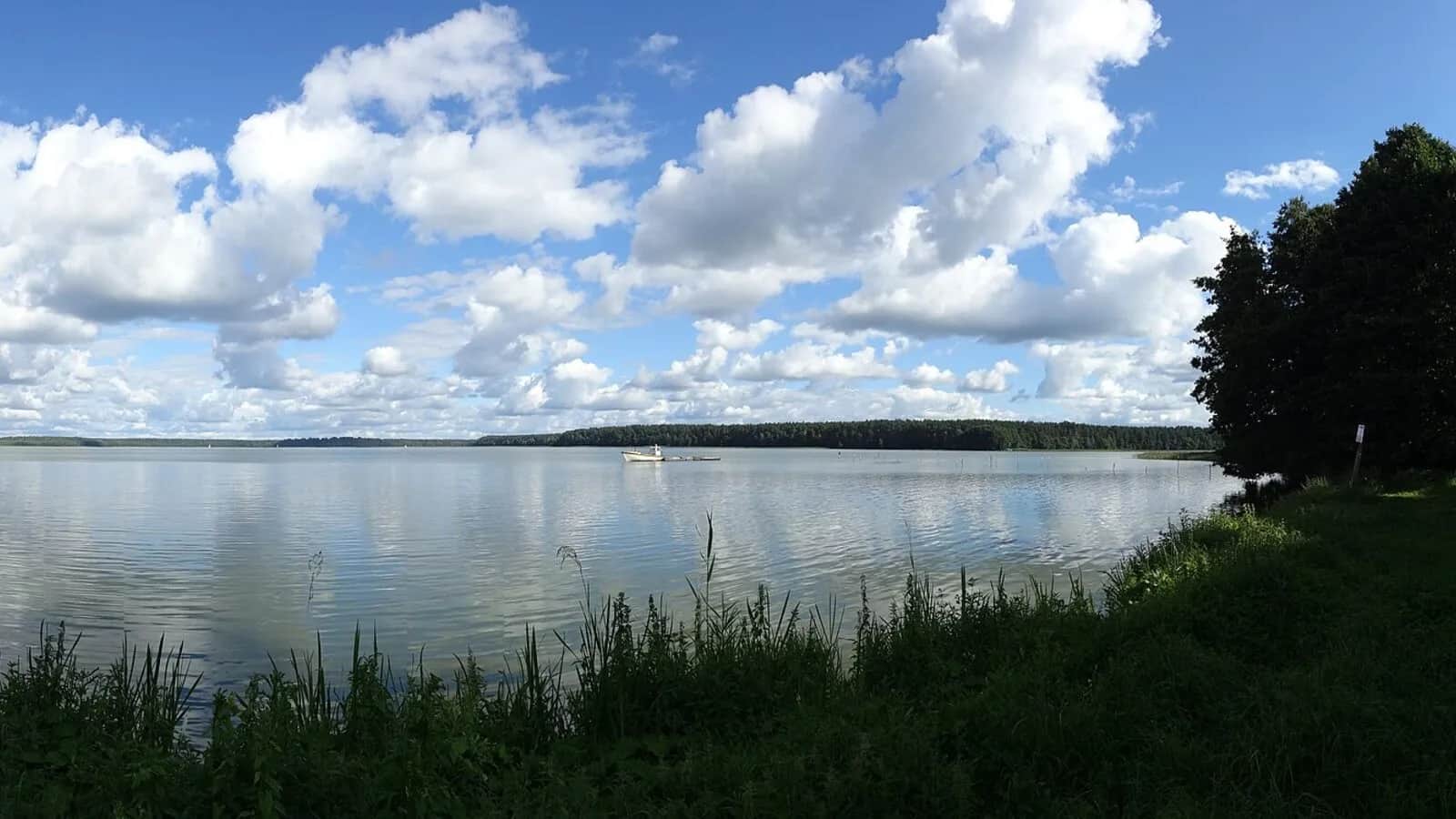
Cover photo: Wojciech Zabolotny, CC BY-SA 3.0, via Wikimedia Commons (Lake Nidzkie, Zamordeje Wielkie Bay)