NaCzarter Team
· Updated
Past Giżycko, the Great Masurian Lakes trail finally opens up. The narrow cuts fall away and the Mamry complex spreads out ahead of the bow: Dargin with three thousand hectares of water, quiet Lake Dobskie where engines are banned, and above Dargin, on a peninsula — Sztynort. The largest yacht harbour on the Great Masurian Lakes, and a few minutes' walk from the quay a baroque palace where the Lehndorff family sat for half a millennium, and where Ribbentrop kept his wartime quarters. This corner comfortably fills two or three days of a cruise: a night on a Y-boom berth, a walk up the oak avenue to the palace, one long tack across Dargin and a full day under sail alone on Dobskie.
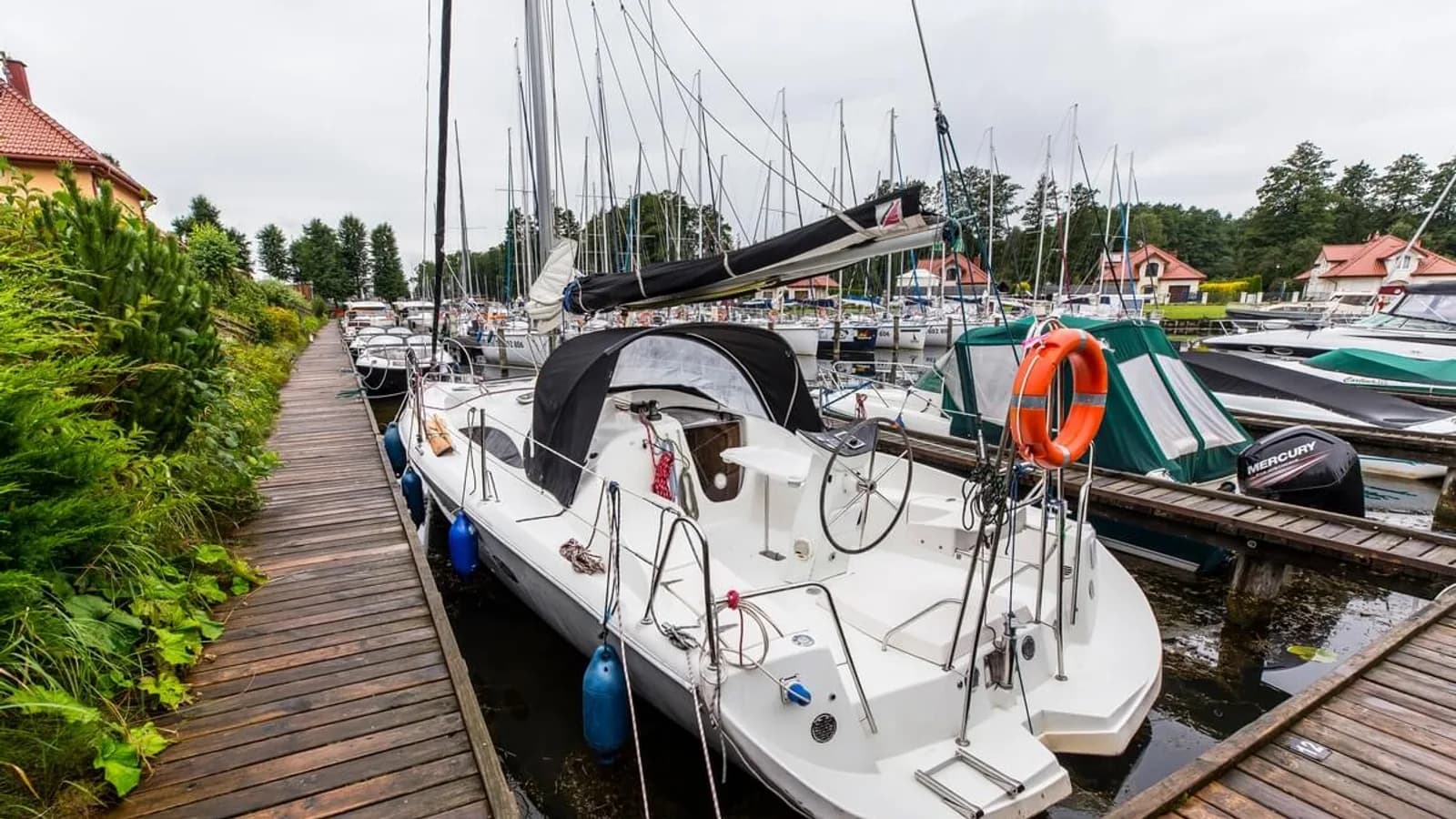
The new Sztynort: over 450 berths on floating pontoons
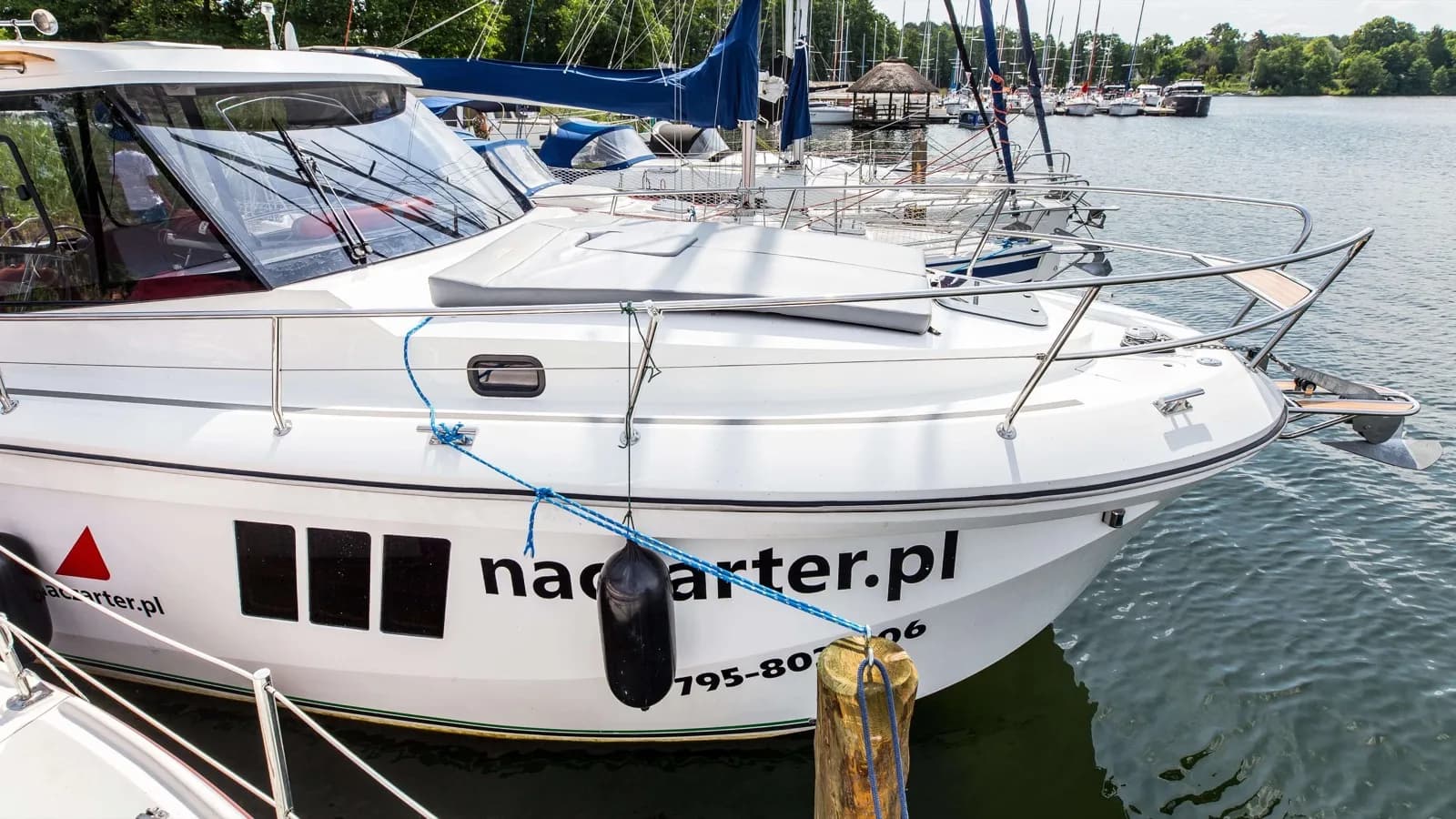
Sztynort's harbour now has more than 450 berths on floating pontoons fitted with Y-booms — more than any other port on the Great Masurian Lakes. A Y-boom berth has one great virtue: you come in bow- or stern-to between the two arms and the boat sits firm even in a stiff breeze, with no fiddling about with an anchor off the water side. Shore power and water at the quay are included in the mooring fee. So are the showers and washrooms — no tokens, no time limit, which after a week on the trail makes a real difference.
The slipway costs from around 50 PLN, the crane lifts up to 4 tonnes, and in summer an Orlen waterside fuel station operates seasonally from 9:00 to 21:00. It is one of the few places on the northern part of the trail where you can refuel straight from the water. The harbour is run by Nowy Sztynort Sp. z o.o. — current price list and details are on the port's official website.
In the evening the harbour runs on its restaurants. The "Zęza" sailors' tavern is an institution — you will struggle to find a Masurian sailor without at least one story from that room. Next door sit the Baba Pruska restaurant and Memuak Café, so there is somewhere to take your coffee before the morning briefing too. Few ports anywhere on these lakes combine 450-plus berths and a full technical base with an evening at Zęza and a baroque palace next door.
The Lehndorff Palace — five hundred years of one family
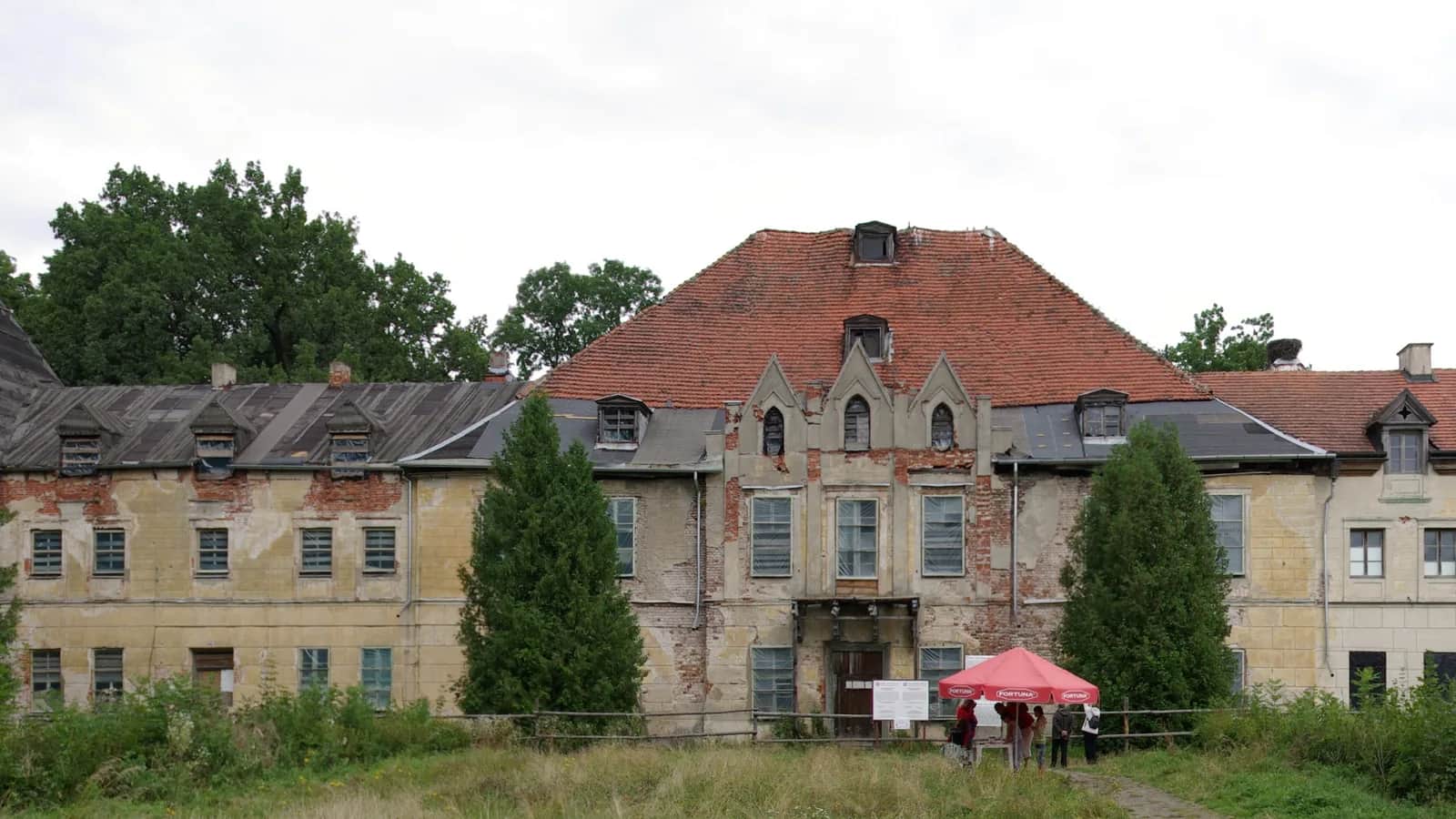
From the harbour to the palace at Sztynort is a walk of a few minutes. The baroque main block went up at the end of the 17th century, after a fire destroyed the earlier manor in 1656. The side wings were added in 1829, the neo-Gothic corner towers between 1860 and 1880. The von Lehndorff family held the estate from the 15th century until 1944/45 — five hundred years in one pair of hands, rare even by East Prussian standards.
The estate's final years make dark, dense history. From 1941 part of the palace housed the field quarters of Joachim von Ribbentrop, the Reich's foreign minister — the Wolf's Lair at Gierłoż was, after all, close by. The last lord of Sztynort, Heinrich von Lehndorff, joined the 20 July 1944 plot against Hitler. He paid with his life — hanged on 4 September 1944 in Berlin's Plötzensee prison. He lived under one roof with Ribbentrop and conspired against Ribbentrop's master; few addresses in Masuria carry that kind of weight.
Since 2009 the palace has been in the care of the Polish-German Foundation for the Protection of Cultural Monuments, supported by the Lehndorff-Gesellschaft Steinort association. The restoration is moving: on 15 November 2025 the renovated front facade of the main wing was unveiled. The interiors are still under works and there is no regular access inside — you view the palace from the outside: the courtyard, the park and the oak avenue planted from the 17th century onwards. A seasonal information point operates, and the foundations stage occasional events; check their current programme before your cruise.
Dargin: plenty of water and one serious trap
Dargin is 30.3 km² of water with depths reaching 37.6 m — the largest lake of the whole Mamry complex. To the south it joins Kisajno, to the west it connects through the Łabap strait with Lake Dobskie, to the north with Kirsajty. There is so much room here that even on an August weekend you can hold one long, clean tack without constantly scanning for other boats.
One spot, though, demands your full attention. About 400 metres south of Sztynorcki Róg lie the "Sztynort stones" — an extensive shallow with a rocky bottom, completely invisible from deck at normal water levels. It is marked with cardinal buoys, and those marks are there to be read, not cut inside because "I've sailed here for years". A rock under the keel ends a cruise more effectively than any calm.
The second thing to remember: the passage from Dargin to Kirsajty runs under the Sztynort Bridge and requires lowering the mast. From there the trail leads across shallow, reed-choked Kirsajty out onto open Lake Mamry — a different kind of sailing altogether, covered in its own guide. If you cannot or would rather not lay the mast down, Dargin and Dobskie make a natural end point for the northern leg.
Dobskie: under sail, no exhaust fumes
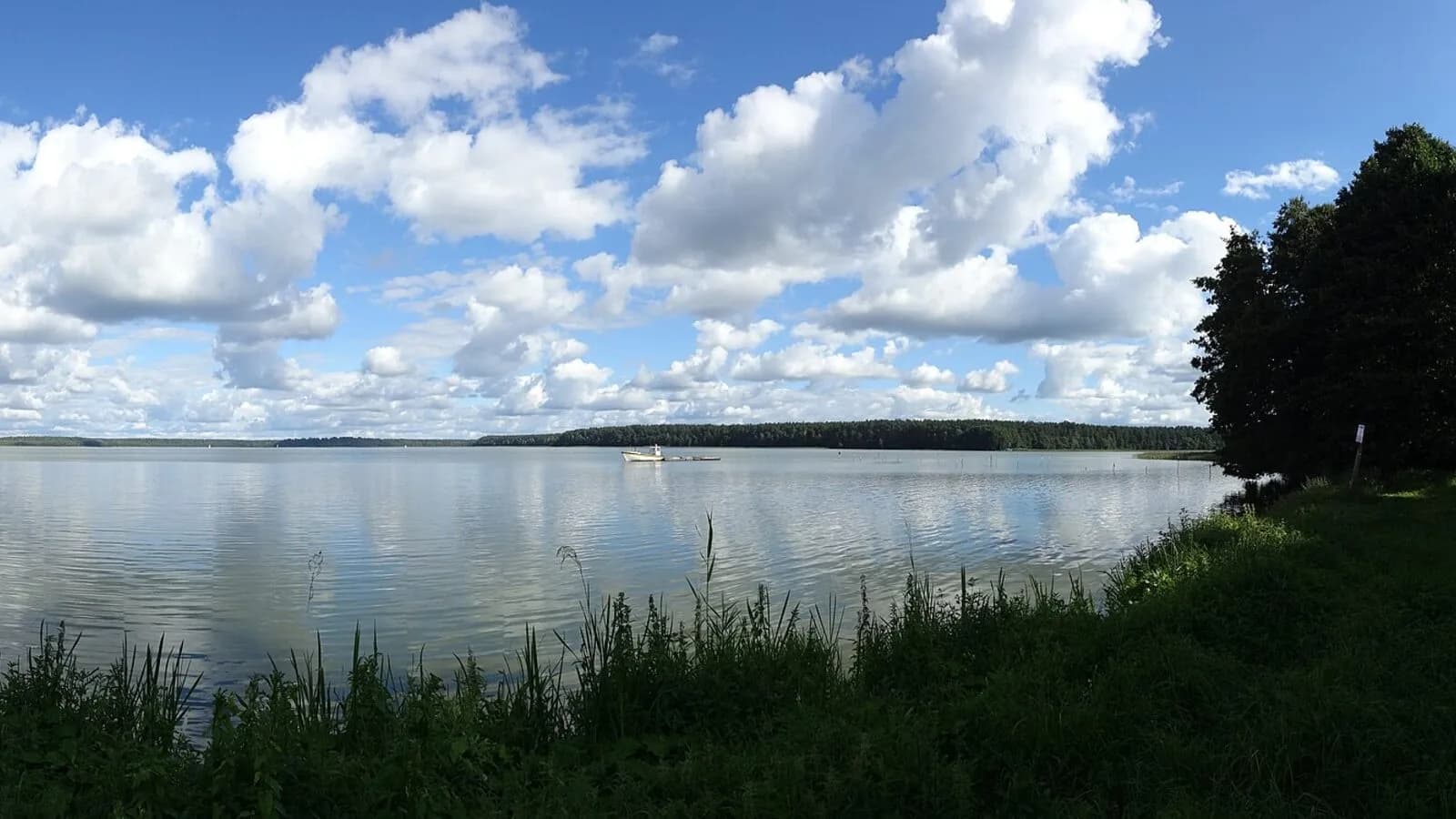
Lake Dobskie covers 1,776 ha and reaches 22.5 m deep, but the first thing you notice is what is missing: the drone of engines. Since 24 May 1976 the entire lake has been the "Jezioro Dobskie" nature reserve, overseen by the Regional Directorate for Environmental Protection in Olsztyn (1,818.47 ha according to the national register). Combustion engines are banned here — the lake is both a silence zone and a water reserve, and the conservation rules formally exclude all motorised craft. Sailing is permitted. The result: you pass through Łabap into water where the only sounds are wind in the rigging and birds. In Masuria that is an increasingly rare experience.
Landing on the reserve's islands is prohibited, and this is not a rule that exists only on paper. Wysoki Ostrów, known as Cormorant Island, holds a breeding colony of around 700 pairs (2011 figures) — you can see it, hear it and smell it from a distance, so nobody needs to go ashore. The reserve also shelters white-tailed eagles; watch the sky patiently and you stand a fair chance of spotting one. Gilma, the lake's largest island, hides a hillfort that researchers link to the Prussian Galindians and the early Middle Ages — and it, too, is viewed strictly from the deck.
On the peninsula between Dobskie, Kisajno and Dargin lies the Fuledzki Róg boulder field: several thousand glacial erratics dragged here by the ice sheet, the largest about 9.3 m in circumference. Protected as a reserve in its own right since 1963, it now forms part of the Dobskie reserve and covers around 40 ha. It is one of the largest boulder fields in Masuria. The regulations do not spell out detailed anchoring rules for Dobskie, so ordinary seamanship applies — how to anchor safely and without damaging the bottom is covered in our guide to anchoring a yacht in Masuria.
How to shape it into a cruise
The navigable route from Giżycko to Węgorzewo runs 25.2 km. From Giżycko itself to Sztynort is about 15 km by water; from Sztynort to Węgorzewo another 13–14 km. Under sail, allow a comfortable half day for each leg — which leaves time for lunch, the walk up to the palace and an evening at Zęza. The marked route out of Sztynort leads through the canal onto Dargin, then along the lake's eastern shore, under the Sztynort Bridge (mast down!) and through the reeds of Kirsajty onto Mamry. For a night away from the harbour, sailors recommend the Królewski Róg headland with its bivouac site. With more time in hand, this whole area earns its place on a longer Great Lakes itinerary — the northern end of the trail is at its best when nobody is in a hurry.
For crews arriving by land: Sztynort is a village in the Węgorzewo commune, set on a peninsula. From the DK63 national road you drive in via Pozezdrze or Ogonki and on through Harsz. From Giżycko it works out at roughly 25–30 km, about half an hour behind the wheel — so picking up a yacht at the harbour on a Saturday afternoon is logistically simple.
Frequently asked questions
How many berths does Sztynort harbour have and what facilities are there? Over 450 berths on floating pontoons with Y-booms — the largest yacht harbour on the Great Masurian Lakes. Shore power, water at the quay and unlimited showers and washrooms are included in the mooring fee; on site there is a slipway (from about 50 PLN), a crane rated to 4 tonnes and a seasonal Orlen waterside fuel station (9:00–21:00).
Can you use an engine on Lake Dobskie? No. The whole lake is a nature reserve and a silence zone — combustion engines are banned, and formally the ban covers all motorised craft. Sailing is allowed; landing on the islands, including Gilma and Wysoki Ostrów, is also prohibited.
Can you visit the Lehndorff Palace in Sztynort? The interiors are under restoration and there is no regular access inside — the palace is viewed from the outside: the courtyard, the park and the historic oak avenue. The front facade was unveiled after renovation on 15 November 2025; a seasonal information point operates and the foundation stages occasional events, so check the dates before your visit.
How do you sail from Sztynort to Giżycko and how long does it take? The water route is about 15 km and forms part of the Giżycko–Węgorzewo trail (25.2 km in total). Under sail, allow half a day for this leg, with a margin for wind and traffic; and if you plan to pass through the canal at Giżycko, check the swing bridge opening hours in advance.
Does the passage from Dargin to Kirsajty require lowering the mast? Yes. The route runs under the Sztynort Bridge and the mast must come down; beyond it you cross shallow, reed-grown Kirsajty onto Mamry. If your yacht has no working mast-lowering system, Dargin marks the natural limit of the cruise.
The simplest way to get to know this area is to start your cruise right here — you take over the yacht at the quay, and Dargin and Dobskie are waiting just beyond the breakwater. Browse the available boats on our yacht charter in Sztynort page and book your dates — the July and August weeks are the first to vanish from the calendar.
Photo: Wikimedia Commons (public domain).