NaCzarter Team
· Updated
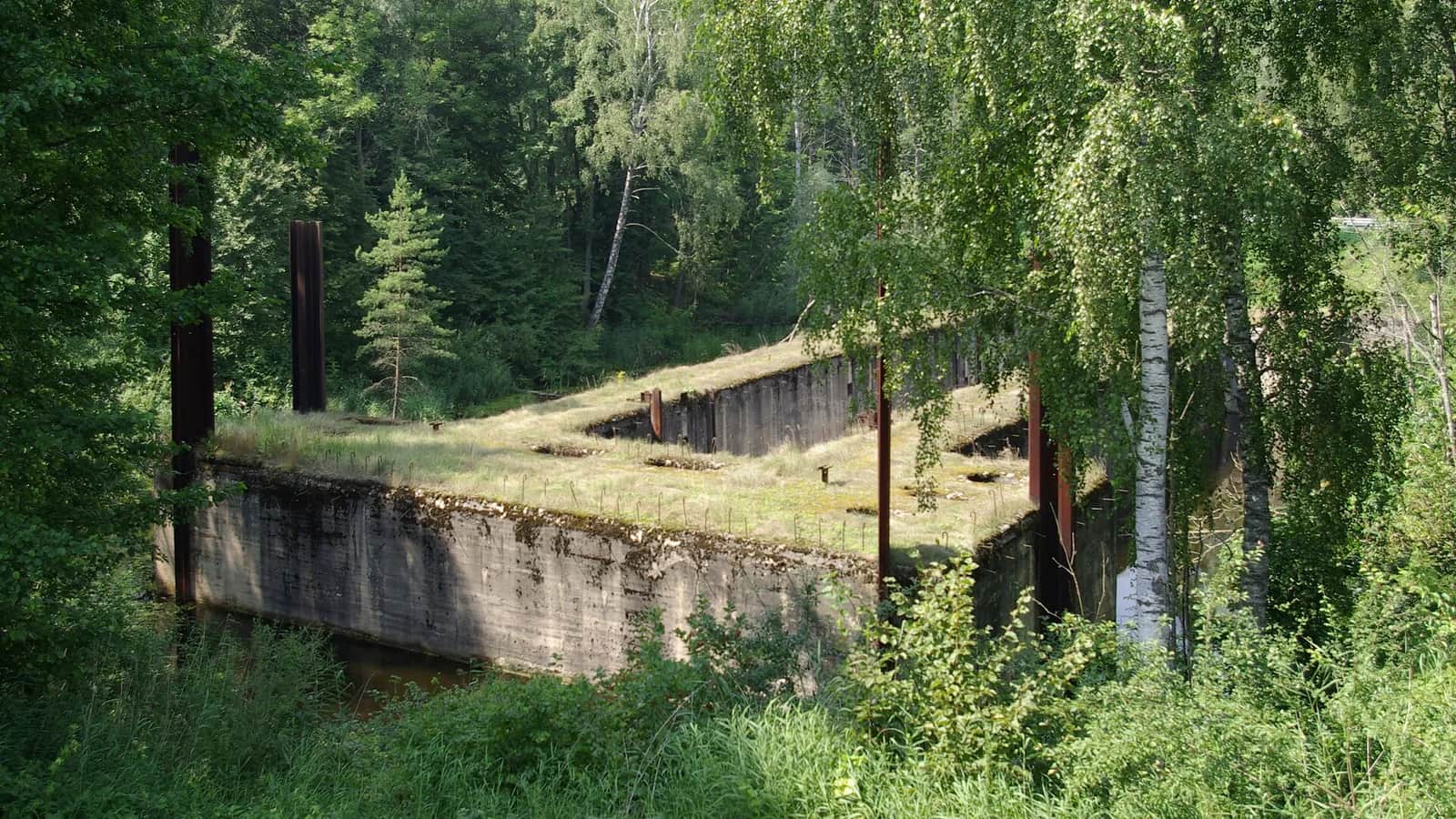
In the forest near Leśniewo, two kilometres north of Lake Mamry, stands a concrete colossus as tall as an apartment block. No waterway leads to it. Not a single barge has ever passed through it. The lock at Leśniewo Górne — the biggest of the five left on the Polish side of the Masurian Canal — has spent more than eighty years waiting for water that will never come. Masuria has no more haunting monument to thwarted ambition: the great route that was to join the Great Lakes to the Baltic ended as a ruin slowly disappearing under moss.
Grain down to Königsberg, coal up to Masuria
The idea was simple and tempting. The Great Masurian Lakes lay a stone's throw from the navigable rivers of East Prussia — all it took was to dig through from Mamry to the Łyna, and from there the Pregolya carried you straight to Königsberg, the region's biggest port. Downstream the canal would carry grain, timber, gravel and building materials; upstream, coal. There were hopes of timber rafting too, and in time the planners began eyeing the drop in water levels as a source of power. Everything was designed on a grand scale: for barges of up to 250 tonnes.
The first designs appeared as early as 1849, with more following in the 1890s. Curiously, they called for inclined planes — exactly the kind still working today on the Elbląg Canal, where boats famously ride across the grass. In the end, though, the engineers settled on conventional locks, only of a size Masuria had never seen before.
Three attempts, three disasters
The Prussian Landtag approved construction in 1908. Work began in April 1911 — and stopped just three years later. The First World War broke out and the building site emptied; work had barely started on two of the locks. The front itself rolled through this corner of Masuria.
The second attempt came around 1919. The Weimar Republic revived the canal as a public-works scheme — it was to provide jobs in a region impoverished by the war. That effort was strangled by the hyperinflation of 1922: the money the labourers were paid in lost its value faster than the embankments could rise.
The third and biggest phase ran from 1934 to 1942. The Third Reich again treated the canal as a weapon against unemployment, and this time the works went full steam ahead — completion was pencilled in for May 1941. For the second time, war proved stronger than the engineers. In 1942 the project was abandoned for good, even though roughly 90% of the earthworks were finished: the channel had been dug along its entire length. What was missing was the hardest part — completing the locks.
After 1945 history added a bitter postscript. The border drawn at Potsdam cut the canal roughly in half, between Poland and the Königsberg region. The waterway meant to connect was itself severed — one of the main reasons construction was never taken up again.

Fifty kilometres, a hundred and eleven metres down
The canal was planned at around 50 kilometres in length, and along the way the water was to descend roughly 111 metres — about the height of a thirty-storey tower. Ten locks with chambers of 45 by 7.5 metres were to handle the drop.
On the Polish side of the border, around 20 kilometres of the canal and five locks remain:
- Leśniewo Górne — a fall of around 17 metres, the largest on the whole canal and the best known;
- Leśniewo Dolne — around 16 metres, today heavily overgrown;
- Piaski (Guja) — around 11 metres, the only fully completed lock on the Polish side;
- Bajory Małe — around 10.5 metres, in the Srokowo district;
- Bajory Wielkie (Długopole) — around 6.5 metres.
The remaining 30 or so kilometres of the route, with five more locks, lie today in the Königsberg region, on the Russian side of the border. For more of the technical detail, see the Masurian Canal entry on Wikipedia.
U-boats in a Masurian forest? Only a legend
A structure this strange was bound to attract myths. The hardiest of them holds that the canal hid a secret U-boat base — or even a U-boat factory. Let's say it plainly: this is a legend, without any historical basis. The canal was never filled with water along its full length, so no submarine could ever have sailed in — or out. It's a colourful tale, happily retold around the campfire, but it has about as much to do with fact as the old Masurian stories of drowned maidens. The true history — three decades of construction wrecked by two world wars and one hyperinflation — is more interesting than the invented one anyway.
The canal today: a trail for cyclists, not helmsmen
One important caveat before anyone starts plotting a cruise: you cannot sail the Masurian Canal today. It is not navigable and not open to navigation — on the Polish side it is managed by Wody Polskie, the state water authority (RZGW). It is a dry-land attraction, for walkers and cyclists. And in that role it works superbly.
Leśniewo Górne is the easiest to reach. You leave the car at the car park on national road 650 and walk the last 500 metres or so through the forest. Entry is free. Up close, the concrete chamber is overwhelming — raw walls, sheer depth, silence, and trees growing where water was meant to flow. A rope park operates here at times, though its condition is best checked on the spot. Leśniewo Dolne, a few hundred metres further down the old route, is heavily overgrown and feels all the more lost for it. Anyone who wants to see how the canal was really meant to look should head for Piaski near Guja — the lock there was finished in its entirety and is the only complete one on the Polish side.
Cyclists have it best of all: the Green Velo trail and the Masurian Cycling Loop both pass close to the canal, and you'll find a description of the canal and the nearby cycling routes at mazury.travel. A day's ride from Leśniewo through Guja to Bajory Małe makes one of the most rewarding historical loops in northern Masuria.
Sailing as close as you can — the canal from the deck of a yacht
Although the locks are explored from land, the canal's beginning can be seen from the water. The route starts on the north-western shore of Lake Mamry, near Mamerki — the same Mamerki that housed the wartime OKH headquarters, the younger sister of the Wolf's Lair at Gierłoż. Mamry lies on the Great Lakes trail, so you pass the canal entrance quite literally from the deck. From there it is about 2 kilometres to the Leśniewo Górne lock — an overland stretch, but a walk, not an expedition.
The natural base is Węgorzewo, the nearest town and the northern terminus of the navigable trail. From here it is also a short hop to Sztynort and lakes Dargin and Dobskie, so a canal day slips easily into a longer cruise around northern Masuria. If you plan to set off from this corner of the lakes, have a look at yacht charter in Węgorzewo.
There is a symmetry in all this that deserves to be seen with your own eyes. In Giżycko, the swing bridge over the Łuczański Canal has been turning for over a century, and the Boyen Fortress stands nearby — proof that Prussian engineers could build things that serve to this day. The Masurian Canal was dealt a worse hand: a project just as ambitious and just as soundly calculated, struck by history three times in a row — with war, with inflation, and with war again. Together, the working bridge and the silent locks say more about Masuria than many a museum.
Frequently asked questions
Can you sail the Masurian Canal by yacht today? No. The canal was never finished, is not navigable and is not open to navigation. The locks and the channel can only be explored from land — on foot or by bike.
Where can you see the locks of the Masurian Canal? Leśniewo Górne is the easiest (car park on road DK650, then about 500 m on foot, free entry). Piaski near Guja — the only fully completed lock on the Polish side — and Bajory Małe in the Srokowo district are also worth the trip. Leśniewo Dolne is heavily overgrown.
Why was the Masurian Canal never finished? Construction, begun in 1911, was interrupted in turn by the First World War, the hyperinflation of 1922 and finally the Second World War — in 1942 the works were abandoned for good. After 1945 the Potsdam border cut the canal in half, which buried any return to construction.
How far are the locks from Lake Mamry and the sailing trail? The canal begins on the north-western shore of Mamry, near Mamerki — the entrance is visible from the deck. From there it is about 2 km on foot to the Leśniewo Górne lock. The nearest town and port is Węgorzewo.
Was there a U-boat base in the Masurian Canal? No. It is a popular legend, but a historically groundless one — the canal was never filled with water along its full length, so no vessel could ever have entered it.
The Masurian Canal tastes best as a stop on a cruise: sails on Mamry in the morning, an afternoon walk among the concrete giants, an evening mooring in Węgorzewo. If you would like to sail the route the barges were meant to take, carrying grain down to Königsberg — or at least its navigable stretch — browse our fleet and rent a yacht in Masuria. From the quay in Węgorzewo to the canal entrance below Mamerki, it is barely a few tacks.
Cover photo: Janericloebe / Wikimedia Commons (public domain).